

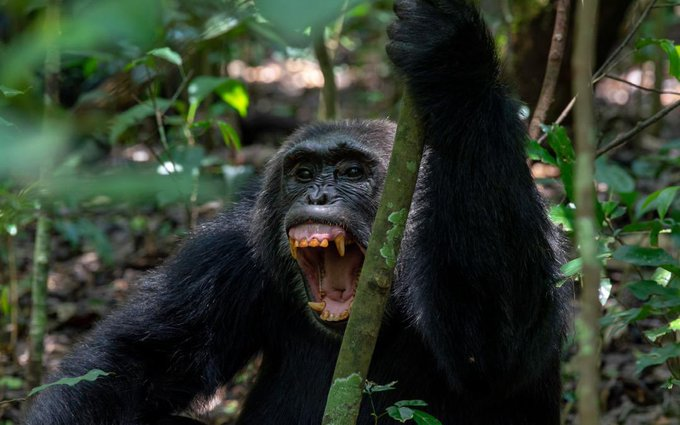
KIBALE — A rare and violent conflict has been recorded among chimpanzees in Kibale National Park, where the largest known chimpanzee community in the area has split into rival groups in what researchers are describing as a “civil war.”
According to the Uganda Tourism Board, the Ngogo chimpanzee community—once numbering about 200 individuals living together peacefully for over two decades—has experienced a dramatic breakdown in social cohesion, leading to deadly territorial clashes.
“As we speak, about 24 individuals have been lost, including 17 infants and seven males,” the tourism body said in a statement shared online. “This reflects early human-like conflict patterns, especially linked to territory.”
The Ngogo community, one of the most studied chimpanzee groups in the world, had long been considered unusually stable due to its large size and cooperative behaviour. However, recent observations indicate a fission into smaller factions, now engaging in aggressive patrols and attacks on former group members.
Researchers say such violence is extremely rare. “The very first observed fight was recorded to happen once every 500 years. This is history,” the Uganda Tourism Board noted.
Chimpanzees, which share about 98.8 percent of human DNA, are known for their complex social systems, intelligence, and capacity for cooperation. But they can also display organised aggression, particularly in disputes over territory and dominance.
The ongoing conflict in Kibale has drawn international scientific attention, with experts describing it as one of the clearest examples yet of sustained lethal aggression within a single chimpanzee community.
Observers say the phenomenon may offer deeper insights into the evolutionary roots of human conflict. Some researchers have linked the clashes to competition for resources and mating opportunities, mirroring patterns seen in early human societies.
Despite the scientific significance, conservationists warn that the losses are a setback for an already vulnerable species. Chimpanzees are classified as endangered, and internal conflicts of this scale could further threaten population stability.
Authorities and researchers continue to monitor the situation closely, as the once-unified Ngogo community navigates a violent and unprecedented chapter in its history.