



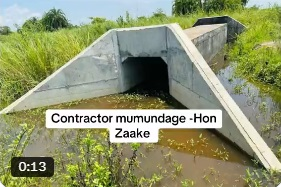
KAMPALA — A Parliamentary field inspection of government infrastructure projects has raised fresh questions over the quality, cost and implementation of road and bridge projects after lawmakers encountered a small culvert-like crossing that was presented as part of the government’s infrastructure commitments.
The inspection was conducted by the Parliamentary Committee on Government Assurances and Implementation, chaired by Mityana Municipality MP Francis Zaake, as the committee continues to verify whether government promises are translating into completed projects on the ground.
The committee has been carrying out field visits to several districts to assess infrastructure projects, including bridges and roads.
Footage circulating from the inspections has triggered public debate over the size and apparent nature of one of the structures, with claims on social media putting its cost at about US$350,000 (Shs1.3bn), while other reactions have cited a figure of about US$27,000 (Shs100m).
However, the exact cost of the structure could not be independently verified from publicly available official records by the time of publication. The figures should therefore be treated as claims pending documentation from the responsible ministry, local government or contractor.
The controversy comes against the backdrop of a wider parliamentary inquiry into delayed and incomplete bridge projects.
On August 11, the Committee on Government Assurances and Implementation demanded answers from the Ministry of Works and Transport over delays in fulfilling government commitments to construct more than 30 bridges on national roads.
The committee’s mandate is to follow up government assurances and determine whether commitments made by the Executive are actually implemented. Parliament lists the Government Assurance and Implementation Committee as one of its standing committees.
Zaake was designated chairperson of the committee at the beginning of the 12th Parliament. Parliamentary records show that the committee includes legislators from across the political divide.
The scrutiny has also attracted attention because of the scale of the committee’s workload. Speaking during an orientation of parliamentary committees earlier this month, Zaake said the committee had more than 230 government assurances to track and argued that field monitoring was necessary to establish whether commitments were being implemented.
Deputy Speaker Thomas Tayebwa said the committee’s work should focus not simply on exposing failures but on pushing ministries, departments and agencies to deliver on government commitments.
The latest inspection has nevertheless revived a basic question that follows almost every public infrastructure controversy in Uganda: what exactly did government pay for?
A structure may look small after completion while its contract includes excavation, drainage works, foundations, approaches, land works, engineering, supervision and other components. But that is precisely why the public needs to see the bill of quantities, contract value, scope of works, payment certificates and completion records before conclusions can be drawn.
Uganda’s Auditor General has previously documented cases involving culverts where materials were procured but some were not accounted for, while poorly executed drainage works created safety risks.
The Ministry of Works and Transport’s budget documents also show that road and bridge projects can involve costs beyond the physical structure itself, including feasibility studies, engineering, supervision and other project-related expenditure.
The committee’s inspections therefore place a more fundamental issue before government: whether the money allocated to infrastructure is producing infrastructure of corresponding value.
For now, the alleged US$350,000 price tag remains unverified. The definitive answer should come from the procurement and project records rather than the appearance of the structure alone.
The committee’s field visits may provide the first step. The paperwork should provide the verdict.

