

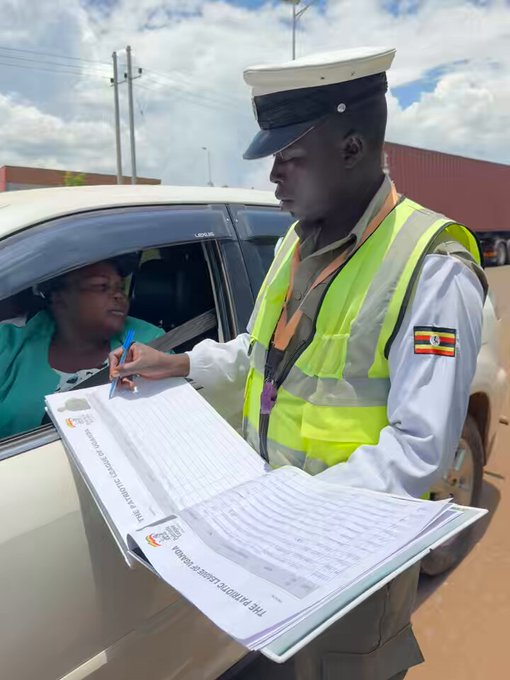
A routine traffic stop on Jinja Road in Mukono has drawn attention after uniformed Uganda Police officers reportedly signed an endorsement book supporting Gen Muhoozi Kainerugaba, amid an ongoing signature drive by his Patriotic League of Uganda (PLU).
Mukoome Paul, a PLU supporter and prospective parliamentary candidate, posted photographs and video on X on September 22 showing the officers signing what he described as an endorsement book for Kainerugaba in Mukono District.
“Earlier today we were stopped by traffic at Jinja road when they requested for permit we provided an endorsement [for] @mkainerugaba book for Mukono district and they signed,” Mukoome wrote, tagging the Uganda Police Force and several PLU figures.
The post did not identify the officers by name or rank, and the circumstances surrounding the signatures could not independently be established from the material posted online.
The incident has nevertheless triggered debate because Ugandan law places restrictions on political activity by members of the security services.
Section 16 of the Political Parties and Organisations Act states that members of the Uganda Police Force, Uganda Peoples’ Defence Forces and Uganda Prisons Service, among other public officials, may not participate in certain political party activities. The law specifically prohibits them from canvassing in support of a political party or a candidate standing for public election sponsored by a political party or organisation.
The Constitution establishes the Uganda Police Force as a national institution whose functions include protecting life and property, maintaining law and order, preventing and detecting crime and cooperating with civilian authorities and the public.
The Police Act similarly requires the Force to protect individual rights, enforce the law and ensure public safety and order. Its disciplinary code requires officers not to compromise law enforcement because of “relationship, patronage or any other influence.”
The legal restrictions are distinct from the constitutional political rights enjoyed by citizens generally, including freedom of expression, association and peaceful assembly. The question raised by the Mukono incident is therefore not simply whether an individual can support a political candidate, but whether uniformed officers may publicly participate in political endorsement while acting in their official capacity.
Kainerugaba, the Chief of Defence Forces and son of President Yoweri Kaguta Museveni, has emerged as the central figure in PLU’s political mobilisation. The organisation has been conducting a nationwide exercise to collect signatures and endorsements in support of his political ambitions.
Mukoome’s post presented the officers’ signatures as an expression of support, ending with the slogan “Viva” and tags to PLU officials.
The Uganda Police Force had not, in the material reviewed for this report, publicly explained why the officers signed the book or whether they were acting in an official capacity when they did so.
The episode comes as political activity around PLU and Kainerugaba continues to expand, raising a broader institutional question: where does an individual security officer’s private political freedom end and the neutrality expected of a uniformed public institution begin?