

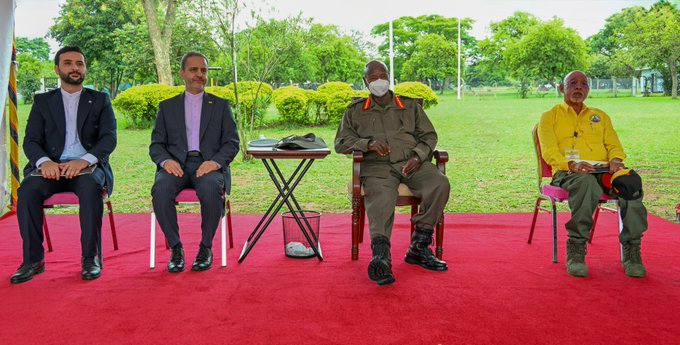
KYANKWANZI — Yoweri Kaguta Museveni on Saturday hosted Iran’s ambassador to Uganda, Majid Saffar, in a meeting focused on strengthening bilateral cooperation, even as controversial remarks by his son, Muhoozi Kainerugaba, sparked debate over Uganda’s foreign policy posture.
In a brief statement shared online, Museveni said the meeting took place at the National Leadership Institute in Kyankwanzi and centred on issues of mutual interest between Kampala and Tehran.
“I welcomed His Excellency Majid Saffar, the Iranian Ambassador to Uganda, who called on me this afternoon in Kyankwanzi. We discussed issues of mutual interest and cooperation between Uganda and Iran,” the President said.
Contrasting signals
The diplomatic engagement comes just days after Gen. Muhoozi Kainerugaba, who also serves as Uganda’s Chief of Defence Forces, made a series of posts on X (formerly Twitter) expressing strong support for Israel.
In the posts, Muhoozi pledged to deploy Ugandan troops to defend Israel and made remarks suggesting a large force could be mobilised against Iran — statements that have not been backed by any official government policy.
The comments triggered mixed reactions online, with some users praising Uganda’s continued diplomatic engagement with multiple global partners, while others questioned the apparent contradiction between official state diplomacy and personal statements from a senior military figure.
Uganda’s balancing act
Uganda maintains relations with both Iran and Israel, reflecting its long-standing foreign policy approach rooted in the principles of the Non-Aligned Movement.
Analysts say Kampala often seeks to balance strategic, economic, and security partnerships across different geopolitical blocs, avoiding firm alignment in global conflicts.
Saturday’s meeting with the Iranian envoy signals continuity in Uganda’s diplomatic engagement with Tehran, particularly in areas of trade, energy, and technical cooperation.
Public reaction
Online discussion following the developments has been dominated by speculation over internal policy coherence, with some observers framing the situation as a contrast between formal state diplomacy and outspoken commentary on social media.
Government officials have not issued any formal clarification regarding the remarks by the Chief of Defence Forces.
Despite the debate, Uganda’s official position on international conflicts is typically communicated through the Ministry of Foreign Affairs and the President’s office, with an emphasis on dialogue, sovereignty, and non-alignment.