

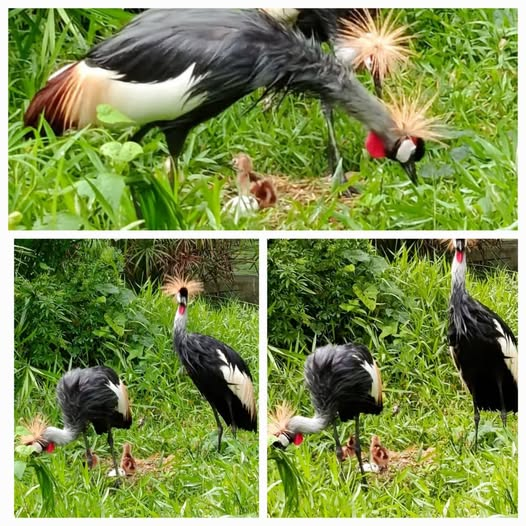
ENTEBBE — The Uganda Wildlife Authority (UWA) has announced the successful hatching of three Grey Crowned Crane chicks at the Uganda Wildlife Conservation Education Centre, commonly known as Entebbe Zoo, marking another milestone in the conservation of Uganda’s national bird.
According to UWA, the triplet chicks hatched between May 27 and 28, 2026, and are reported to be in good health following assessments by animal caretakers and veterinary doctors at the facility.
The development represents the fourth successful ex-situ breeding of Grey Crowned Cranes at Entebbe Zoo, underscoring the effectiveness of ongoing conservation efforts aimed at protecting the endangered species.
UWA attributed the breeding success to the professional animal welfare standards maintained by its experts, the semi-wild environment provided at the conservation centre, and other favorable conditions that support the birds’ reproduction and survival.
“The triplet chicks are in good health, as confirmed by animal caretakers and veterinary doctors,” the authority said in a statement.
The Grey Crowned Crane, Uganda’s national bird, is listed as endangered on the International Union for Conservation of Nature (IUCN) Red List. Conservationists estimate that Uganda’s population currently stands at between 12,000 and 14,000 birds.
Wildlife experts warn that the species continues to face significant threats, including habitat loss caused by wetland degradation, increasing human-wildlife conflict, and illegal trafficking.
The successful hatching is expected to boost conservation efforts and raise awareness about the importance of protecting wetlands and other critical habitats that support the survival of Grey Crowned Cranes in the wild.
UWA has in recent years intensified conservation and breeding programs to help reverse the decline of the species, with Entebbe Zoo playing a key role in research, public education, and the preservation of Uganda’s biodiversity.
The arrival of the three chicks has been welcomed by conservationists as a positive step toward securing the future of one of Uganda’s most iconic and cherished wildlife species.