

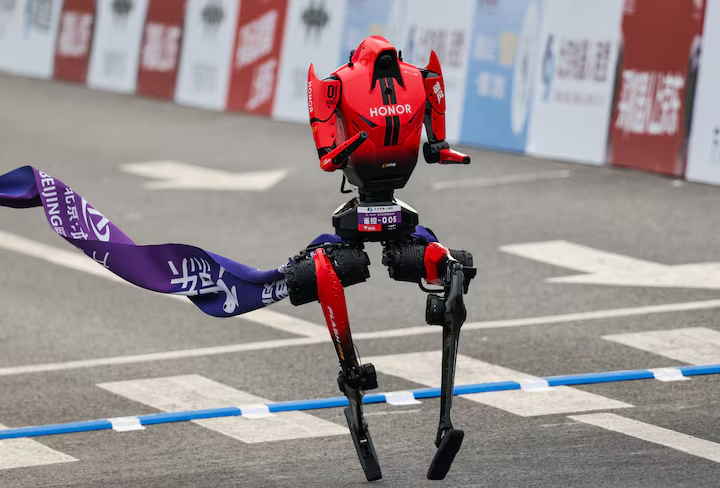
BEIJING, Aug 23 (Reuters) — A Chinese humanoid robot has run 100 metres in 9.39 seconds at the World Humanoid Robot Games in Beijing, beating the men’s world record set by Jamaican sprinting legend Usain Bolt.
Tiangong Ultra, developed by the Beijing Humanoid Robot Innovation Center, won its preliminary heat at the second edition of the games on Saturday, according to organisers.
The robot’s time was 0.19 seconds faster than Bolt’s 9.58-second world record, set at the 2009 World Athletics Championships in Berlin.
But the machines’ performance lacked the effortless finish associated with elite human sprinters.
Tiangong Ultra stumbled dramatically after crossing the finish line and veered towards the sidelines, forcing spectators to move out of its path before crashing into a protective mat.
Honor’s humanoid robot Lightning, which had led early in the race, finished second in 9.47 seconds — also faster than Bolt’s record.
Lightning was later carried away on a stretcher after collapsing at the finish.
The results nevertheless represent a dramatic improvement from last year’s inaugural games, when Tiangong Ultra won the 100 metres in 21.50 seconds.
Tiangong also won the world’s first humanoid robot half-marathon, held in Beijing last year.
Earlier on Saturday, Chinese state media reported that Lightning had clocked 9.32 seconds in a preparatory 100-metre test, reaching a peak speed of 14.5 metres per second.
Lightning also won this year’s humanoid half-marathon in April in 50 minutes and 26 seconds, a pace faster than the current human men’s world-record marathon pace.
For the games, Lightning’s designers modified its physical structure. The robot stood 169 cm tall and had 95-cm legs during the half-marathon. Researchers later lengthened its legs by 10 cm to 1.05 metres, according to Chinese broadcaster CCTV.
The 100 metres is one of 51 events at this year’s games, which also include football, dancing and industrial-task competitions.

China bets on humanoid robots
The spectacle reflects a much larger industrial ambition.
China has identified humanoid robots as a strategic emerging industry, with policymakers and companies investing heavily in the combination of artificial intelligence, robotics and advanced hardware.
The goal extends beyond sporting competitions. Chinese companies are developing humanoid robots for manufacturing, logistics and consumer applications, betting that improvements in AI and mechanical engineering will accelerate their adoption.
Investor enthusiasm has also surged.
Shares in Unitree, one of China’s best-known humanoid robot makers, rose more than fivefold during its Shanghai trading debut on Wednesday, giving the company a market value of about $50 billion.
The scale of the Beijing competition has also expanded sharply. This year’s games have attracted 2,056 robots representing 666 teams from 16 countries across six continents, compared with 280 teams at the inaugural event.
The competition is being held at Beijing’s National Speed Skating Oval and runs through Wednesday.
The sight of a machine running faster than Bolt’s recorded world time is spectacular. But it also exposes a strange new frontier.
The question is no longer simply how fast humans can run.
It is how far machines can go once speed, artificial intelligence and engineering begin to evolve together — and whether the future of competition will still be about humans trying to outrun one another, or machines trying to outrun us.