
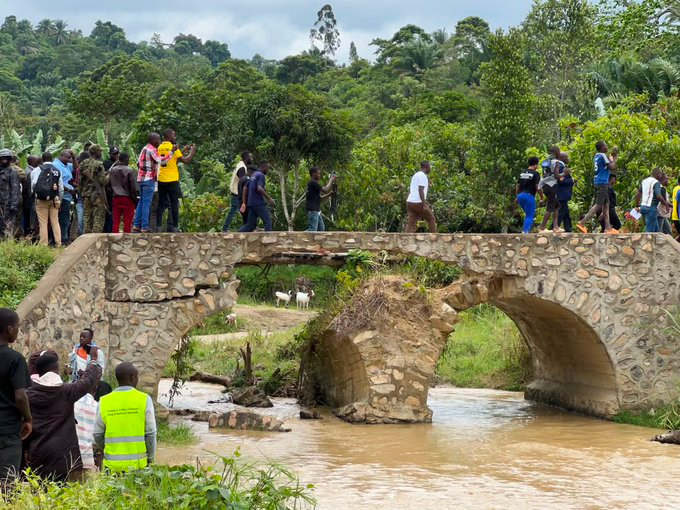
BUNDIBUGYO — Minister of State for Local Government Barugahara Balaam Ateenyi has called for investigations into the collapse of the Shs350 million Tokwe Bridge in Bundibugyo District, questioning how public funds could have been spent on infrastructure that reportedly failed before it was commissioned.
Balaam raised the concerns during an inspection of the bridge on Saturday, August 22, after finding the structure in ruins.
According to the Ministry of Local Government, the bridge, which connects communities in Kanyamwerima, Bundinyama and Hakitara to Bundibugyo Town, is no longer passable. Residents have resorted to using a makeshift wooden crossing over the remains of the structure to access markets, schools and health facilities.
The minister said the condition of the bridge raised serious questions about the quality of construction and the management of public resources.
“This is broad daylight theft of government money. How can someone build a bridge worth 350 million without any iron bars? This is unacceptable and we will not tolerate it,” Balaam said, according to the Ministry of Local Government.
In a statement posted on his social media accounts, Balaam asked officials to establish who designed, supervised, certified and paid for the project, as well as who approved the works.
“Where did the money go? Who designed, supervised, certified and paid for these works? Who approved them? Who benefited?” he asked.
He said every person found to have misappropriated funds meant for the bridge should be held accountable.
“Whoever ate even a cent meant for these bridges will vomit it,” Balaam said, declaring that the government would pursue a “zero tolerance” approach to corruption and demand value for money in public projects.
Five bridges and counting
The collapse of Tokwe Bridge comes against a long history of infrastructure damage in Bundibugyo, one of Uganda’s districts most exposed to floods, landslides and other disasters.
In 2019, floods washed away six bridges in the district, paralysing transport in several areas. The affected structures included bridges on the Chabbi, Butogo and other rivers.
In 2022, floods and mudslides caused even greater destruction, with more than 30 bridges reportedly washed away in a single episode, cutting communities off from schools, health centres and markets.
More recent reporting has continued to document damage to the district’s fragile road network. In 2025, the River Tokwe bridge was again reported damaged, cutting off Kanyamwerima, Bundinyama and Hakitara from Bundibugyo Town.
The problem, however, may not always be explained by corruption or poor workmanship alone.
Bundibugyo is exceptionally vulnerable to flooding and landslides, and district officials have previously linked some infrastructure failures to extreme weather. In 2024, the district banned sand and stone mining along riverbanks after officials warned that the practice contributes to riverbank erosion and changes watercourses, increasing the vulnerability of bridges during heavy rains.
That makes the Tokwe case particularly important: was the bridge destroyed by nature, by poor engineering, by inadequate materials, or by some combination of all three?
Only a technical and financial investigation can establish that.
Officials arrested as scrutiny widens
The Tokwe inspection formed part of a wider anti-corruption and service-delivery campaign by the Ministry of Local Government in Bundibugyo.
The ministry reported that the Town Clerk and Commercial Officer of Bundibugyo Town Council were arrested during a public Baraza following complaints concerning collapsed bridges and alleged extortion under the Parish Development Model.
Residents reportedly told officials that the River Tokwe bridge had suffered damage and that repeated warnings about cracks and poor drainage had not resulted in engineering inspections.
The arrests do not, by themselves, establish wrongdoing. The allegations remain subject to investigation.
But they illustrate the wider question now confronting local government: what happens between the moment government allocates money for a public project and the moment a citizen is expected to use it?
A bridge does not collapse only when concrete breaks.
It can also collapse earlier — when specifications are ignored, supervision becomes ceremonial, certification becomes paperwork and public money becomes somebody’s private opportunity.
For Balaam, the Tokwe bridge is now a test of whether government can trace that chain.
He said government provides resources for infrastructure and services, but corruption, poor supervision and shoddy workmanship can prevent those resources from reaching the people they are intended to serve.
He also praised President Yoweri Museveni’s government for providing resources while arguing that leaders and citizens have a responsibility to ensure those resources are properly used.
“Value for money. Improved service delivery. Uganda must work for Ugandans,” he said.
The immediate task, however, is more concrete: establish how a Shs350 million bridge came to lie in ruins, determine whether the failure was caused by flooding, defective design or workmanship, establish who was responsible for inspection and certification, and recover any public money lost through wrongdoing.
Because for the residents forced to cross River Tokwe on a precarious wooden structure, the accounting question is not abstract.
They have already paid for the bridge.
They still do not have one.