

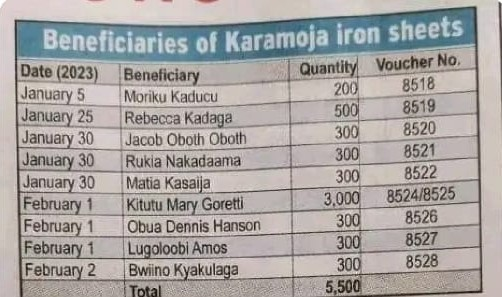
KAMPALA — A detailed list of senior government officials linked to the Karamoja iron sheets scandal has resurfaced online, reigniting public anger and debate over accountability in one of Uganda’s most high-profile corruption cases in recent years.
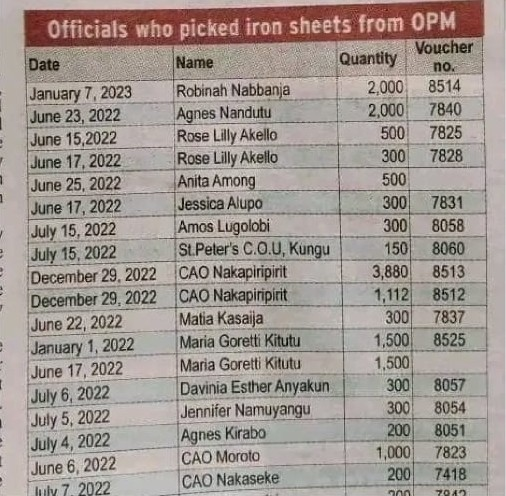
The document, widely shared on social media, appears to be a reproduction of an official record or media report. It outlines names, dates, and voucher numbers tied to the distribution of iron sheets that were originally procured under a government program intended to support vulnerable communities in the Karamoja sub-region.
High-Profile Names Re-emerge
The list categorises recipients into “beneficiaries” and “officials who picked iron sheets from OPM,” featuring several senior figures in government.
Among those named are Vice President Jessica Rose Epel Alupo, Speaker of Parliament Anita Annet Among, Prime Minister Robinah Nabbanja, and Finance Minister Matia Kasaija.
Also listed are former Karamoja Affairs Minister Mary Goretti Kitutu and State Minister for Planning Amos Lugoloobi, among others, alongside district officials from Karamoja.
Nandutu Case Revives Focus
The renewed circulation of the list comes against the backdrop of ongoing legal consequences for some implicated officials, most notably former State Minister for Karamoja Affairs, Agnes Nandutu.
Nandutu was arrested, prosecuted, and later jailed after being found guilty in connection with the diversion of iron sheets meant for Karamoja communities. Her conviction marked one of the most decisive outcomes in the scandal, which had initially implicated dozens of senior officials.
Similarly, Mary Goretti Kitutu, who oversaw the docket at the centre of the controversy, faced prosecution over alleged mismanagement and diversion of relief items. Several other officials were investigated, with some returning the iron sheets or refunding their value, while others maintained their innocence.
“The Optics Still Stink”
The viral post accompanying the list carries a pointed message: “I DON’T KNOW ABOUT THE SUBSTANCE; BUT THE OPTICS STINK, Mr. President!”—capturing a broader public sentiment that, regardless of legal outcomes, the scandal has left a lasting dent on trust in public institutions.
While some leaders previously stated that the iron sheets were used for community projects or returned to the Office of the Prime Minister of Uganda (OPM), the reappearance of specific allocation details and voucher references has revived scrutiny.
Pressure on Anti-Corruption Narrative
The resurfacing of the list comes at a politically sensitive time, as Yoweri Kaguta Museveni continues to emphasize a tough stance against corruption, recently telling ruling party leaders that “the corrupt are now an endangered species.”
However, analysts say the persistence of the “Mabaati” scandal in public discourse underscores the gap between political messaging and public perception.
Originally exposed in early 2023, the scandal involved thousands of iron sheets intended for disarmament and livelihood support programs in Karamoja but allegedly diverted to politically connected individuals.
As Uganda approaches the 2026 general elections, the issue remains a potent symbol of governance challenges, with the resurfaced list serving as a reminder that, for many citizens, the matter is far from settled.