

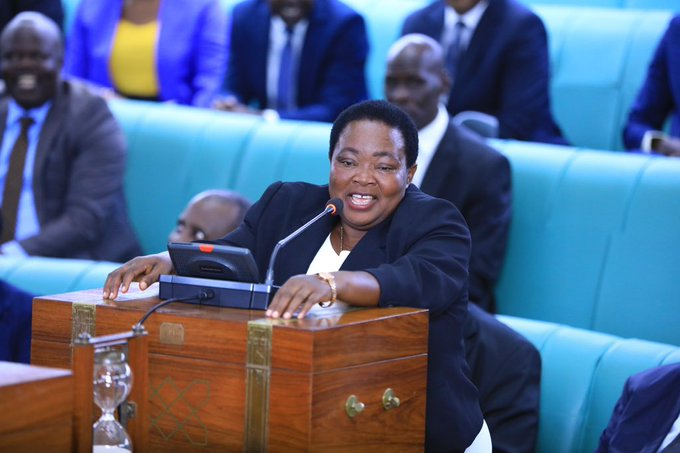
KAMPALA — The Government is considering a review of taxes on imported textiles and garments following a strike by Kampala traders, with Prime Minister Robinah Nabbanja telling Parliament that President Yoweri Kaguta Museveni has directed her to present a Cabinet paper on the matter.
Nabbanja said the proposed review would examine how Uganda’s tax policy could be aligned with that of other East African Community (EAC) member states, amid complaints by traders that the current tax regime makes it difficult to compete with businesses in neighbouring countries.
“The President has requested traders to suspend their strike and resume selling their merchandise until Tuesday, 24 November 2026, when we shall give them a clear answer after the Cabinet meeting,” Nabbanja told Parliament on Thursday.
She said the President had telephoned her earlier in the afternoon and instructed her to prepare a Cabinet paper on taxes affecting imported textiles and garments, which she identified as the main issue behind the traders’ protest.
“I have been advised by the President to present a Cabinet paper to Cabinet on the same because we don’t want any more strikes from traders,” she said.
The Prime Minister said the proposed changes would have to be considered by Cabinet and subsequently taken to Parliament, before a final decision is communicated to the traders.
Nabbanja said the government had also agreed to establish an inter-agency revenue harmonisation committee to provide a platform for resolving disputes between traders, the Uganda Revenue Authority (URA) and other government agencies.
The committee, which will be chaired by the Minister of Trade, will bring together traders’ representatives and the URA Commissioner General to address tax concerns before they escalate into further industrial action.
“We don’t want a repeat of strikes in the city,” she said.
She told MPs that traders had complained about the absence of a formal forum where they could raise grievances with both URA and government.
At a meeting on November 17 involving the government, Kampala City Traders Association (KACITA) and other traders’ representatives, the concerns included taxes on goods brought into Uganda from Kenya, delays in clearing consignments and repeated enforcement operations.
Nabbanja also disclosed that she had directed URA to review the deployment of its enforcement teams following complaints that traders sometimes had their goods released by one team, only for another team to impound the same consignments at a roadblock.
She said the problem had created uncertainty and delays for businesses.
The Prime Minister explained that URA had deployed several enforcement teams after some traders allegedly paid taxes in Kenya and transported goods into Uganda in small consignments, using buses as luggage or boda bodas and tuk-tuks.
She said the practice was causing Uganda to lose tax revenue, prompting the authority to intensify enforcement.
President Museveni is scheduled to meet URA and other enforcement officials on Monday, November 23, to discuss the matter, Nabbanja told Parliament.
She said her planned meeting with traders on Thursday had not taken place because she was required to attend Parliament after attempting to consult the President.
“So I have not engaged the traders today,” she said.
Nabbanja said government valued the contribution of all taxpayers, particularly traders, and remained committed to addressing their concerns.
Deputy Speaker Thomas Tayebwa directed the Prime Minister to report back to Parliament on Wednesday, November 25, following her planned engagement with traders and the Cabinet meeting.
Tayebwa said the rules governing Prime Minister’s Time did not allow debate on the statement, but several issues remained unresolved and required further clarification.
“You need to update the House,” he told Nabbanja.
The traders’ strike had seen businesses in Kampala’s downtown commercial areas close their shops in protest against taxation, delays in customs clearance and other costs of doing business.
The government is now seeking to resolve the dispute through a review of textile and garment taxes, improved coordination among enforcement agencies and a formal mechanism for engagement with traders.