

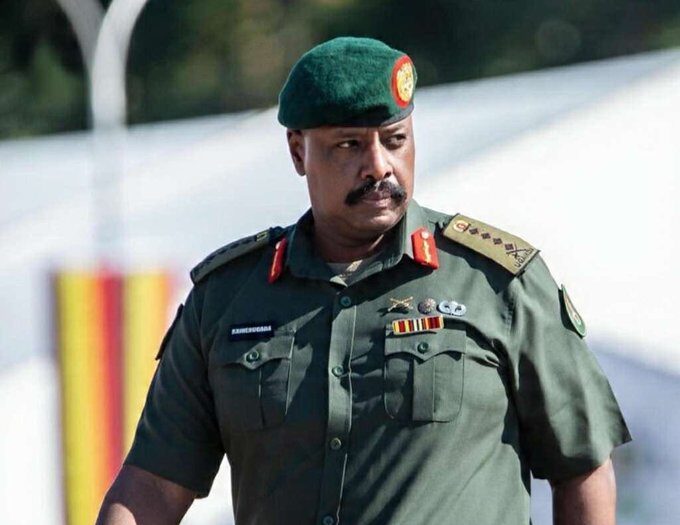
KAMPALA — Chief of Defence Forces (CDF) Gen. Muhoozi Kainerugaba has renewed his intention to contest Uganda’s presidency in 2031, declaring that young people will win the country’s next leadership contest, as a public disagreement with the Uganda Law Society (ULS) escalates.
In a message shared on X on Tuesday, November 17, Gen. Muhoozi said he had taken a short break from social media to prepare for what he described as an inevitable political victory.
“I have taken a short break from social media. I am preparing myself for our inevitable victory in the politics of the country. The young people will win in 2031,” he said in a statement shared by UPDF Acting Director of Defence Public Information Col. Chris Magezi.
The declaration comes amid growing political mobilisation by supporters of Gen. Muhoozi, who is the son of President Yoweri Kaguta Museveni and chairman of the Patriotic League of Uganda (PLU).
Gen. Muhoozi has previously declared his intention to contest the presidency after his father’s tenure, with his supporters already organising activities to build support for a proposed 2031 presidential bid.
In a separate message on Tuesday, the army chief made his intention more explicit, saying: “I am going to stand for the Presidency of this country after Mzee. No one will stop me.”
He added that he placed his hope in God and fellow Ugandans.
The renewed declaration has coincided with a dispute between Gen. Muhoozi and the Uganda Law Society over alleged threats against government critics and reports of abductions.
On November 15, ULS President Isaac Ssemakadde issued a statement calling on Gen. Muhoozi and the PLU to stop what the lawyers described as threats against critics, political opponents, journalists, lawyers and witnesses.
The society also demanded the immediate and unconditional release of three people whose reported disappearances had raised concern: political analyst Egesa Ronald Leonard, opposition activist David Musiri and trainee advocate Prosper Julian Ahabwe.
Ssemakadde warned that threats of disappearance, death and torture against people expressing dissent were criminal offences and violations of constitutional rights. The society also called for investigations into the reported disappearances.
Gen. Muhoozi responded with a strongly worded message, questioning the institution’s legitimacy and referring to it as a “Jokers Club”.
“What is Uganda Law Society? Some kind of Jokers Club? Who are they to threaten God’s Army? Let them send another threat again. They will learn who we are,” he said in a message shared through Col. Magezi’s X account.
The exchange has added another dimension to the debate over Gen. Muhoozi’s political ambitions, particularly concerns about the relationship between the military, political mobilisation and civilian institutions.
Succession debate
Gen. Muhoozi’s presidential ambitions have increasingly featured in discussions about the succession of President Museveni, who has governed Uganda since 1986.
The Patriotic League of Uganda has been mobilising support for his proposed candidacy, with several political figures and groups endorsing him as a potential successor.
However, the succession question has also generated reports of disagreements within the ruling National Resistance Movement (NRM).
Following a November 10 meeting of the party’s Central Executive Committee, reports emerged that some senior members had opposed efforts to position Gen. Muhoozi as Museveni’s successor.
NRM Secretary General Richard Todwong dismissed the reports, insisting that the party had not rejected the general’s presidential ambitions and that official decisions would be communicated through established party channels.
Gen. Muhoozi currently serves as Chief of Defence Forces, a position that presents a legal requirement for his political ambitions.
Section 99 of the UPDF Act provides that a serving military officer who wishes to seek elective political office must first resign or retire from the armed forces in accordance with the applicable regulations.
Although his supporters are already organising around 2031, the NRM has not formally announced its presidential succession arrangements.
President Museveni’s eventual departure from office and the possibility of his son succeeding him therefore remain subjects of political debate, with questions about democratic competition, military involvement in politics and the independence of state institutions continuing to feature in the discussion.