

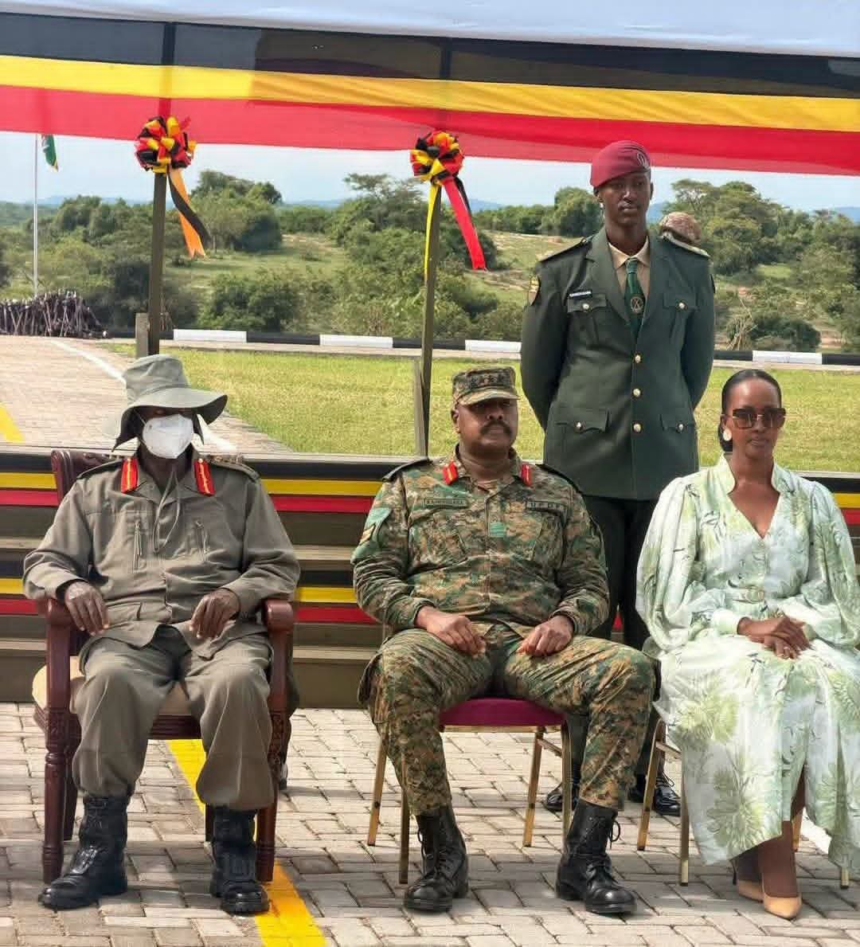
At 22, Ruhamya Kainerugaba has joined the Uganda Peoples’ Defence Forces (UPDF) as a Second Lieutenant after completing military training in the United Kingdom, beginning a career that places him in an institution long associated with his family.
Ruhamya, the son of Chief of Defence Forces Gen. Muhoozi Kainerugaba and grandson of President Yoweri Kaguta Museveni, was commissioned on October 20, 2026, at the Uganda Military Academy in Kabamba, Mubende District. The ceremony was presided over by President Museveni, who is also Commander-in-Chief of the armed forces.
For most young officers, commissioning marks the transition from training to military service. For Ruhamya, it is also a moment shaped by a family history that has kept him in the public eye long before he wore a uniform.
His entry into the military follows a path taken by his father, who trained at the Royal Military Academy Sandhurst in Britain before rising through the ranks to become the country’s Chief of Defence Forces.
Ruhamya graduated from Sandhurst on August 5, 2026, after completing the academy’s 44-week Officer Commissioning Course. He subsequently returned to Uganda for his formal commissioning alongside other newly trained officers.
His graduation attracted attention not only because of the institution he attended but also because of the family name he carries.
Following his father’s path
Gen. Muhoozi joined the military in 1999 and graduated from Sandhurst in 2000. His subsequent career included senior positions as commander of the Special Forces Command and commander of the Land Forces before his appointment as Chief of Defence Forces.
His son’s decision to train at the same British academy creates an obvious parallel between their careers, although the two are at very different stages of their military lives.
In May 2026, Muhoozi publicly expressed pride in Ruhamya’s progress and shared photographs comparing their experiences at Sandhurst, drawing attention to the similarities between their training journeys.
For a father who has spent decades in the armed forces, his son’s commissioning represents a significant family milestone.
But military careers are not inherited in the same way as surnames. Muhoozi has accumulated decades of experience and now occupies the UPDF’s highest professional command position. Ruhamya is beginning his service as a junior officer.
His father’s career provides a point of comparison, but it does not determine what the younger Kainerugaba will become. That will depend on his assignments, performance, leadership and the responsibilities he earns over time.
A family at the centre of power
Ruhamya’s entry into the UPDF comes against the backdrop of his family’s prominent position in Uganda’s political and military establishment.
President Museveni has led Uganda since 1986 and serves as Commander-in-Chief, while Gen. Muhoozi heads the country’s armed forces. Ruhamya’s commissioning therefore places another generation of the family within the military institution.
That connection has made his career a subject of public interest beyond the ordinary significance of a young officer receiving his commission.
For some, his decision to join the UPDF represents a continuation of a family tradition of military service. For others, it raises questions about access, opportunity and the advantages that may accompany proximity to political power.
These questions cannot be settled by his surname alone. Completing training at Sandhurst is a verifiable professional milestone, but neither family connections nor an overseas qualification, on their own, establish an officer’s ability to command.
The more consequential questions concern the opportunities he receives, the standards against which he is assessed and whether his professional advancement follows the same institutional requirements applied to other officers.
There is a distinction between questioning the structures of opportunity and assuming that an individual is either qualified or unqualified because of his family. Both claims require evidence.
Nevertheless, Ruhamya’s position means that his military career is likely to attract more public scrutiny than that of many of his contemporaries.
From Sandhurst to the realities of military service
Graduation from Sandhurst is an important stage in an officer’s development, not the completion of it.
The academy’s training prepares cadets for leadership, decision-making and the demands of military life. Those lessons must subsequently be applied in assignments where discipline, judgment and responsibility have consequences beyond the training ground.
Ruhamya’s commissioning as a Second Lieutenant formally begins that process.
His duties will depend on the assignments he receives within the UPDF. As he gains experience, his ability to lead personnel, exercise sound judgment and meet the demands of military service will shape his professional reputation.
His father’s rise through the ranks offers an obvious comparison, but there is no guarantee that their careers will follow the same trajectory. Advancement depends on several factors, including performance, experience and institutional requirements.
For the younger Kainerugaba, the immediate challenge is to move from military training to the practical responsibilities of an officer.
The burden of a famous surname
Growing up in a family at the centre of national power can bring opportunities, but it also creates expectations that other young people rarely encounter.
At 22, Ruhamya is entering adulthood with a public identity already shaped by his grandfather’s presidency and his father’s position at the head of the military. His commissioning has intensified that visibility.
The surname may open doors, but it can also invite questions about whether achievements are recognised on their own merits. Decisions that would otherwise attract little attention may become matters of public debate, while his performance may be measured against his father’s record.
The challenge is to establish a professional identity distinct from the family name.
His commissioning is a milestone; it is not proof of what his military future will become. The more meaningful test will be how he performs his duties, the responsibilities he is entrusted with and the reputation he builds among fellow officers.
The UPDF’s expectations of discipline and professional conduct apply to every commissioned officer. Public attention may differ, but the demands of service should not.
Whether those standards are applied consistently is a broader institutional question, one that cannot be answered by Ruhamya’s commissioning alone.
A new chapter
Ruhamya Kainerugaba’s commissioning at Kabamba marks the beginning of his military career and extends his family’s association with the armed forces into another generation.
His journey from Sandhurst to the UPDF has placed him in an institution where his father’s military position and his grandfather’s presidency will inevitably influence public perceptions of him.
Yet family history cannot substitute for a military record.
Gen. Muhoozi has spent decades building his career. Ruhamya now has the opportunity, and the responsibility, to build his own.
At 22, he has taken the first formal step. Whether he earns recognition for his own leadership and service will depend on what follows.
For now, his commissioning is both a personal milestone and the beginning of a career that will be watched closely in Uganda, where the relationship between family, power and public institutions remains a subject of continuing debate.