

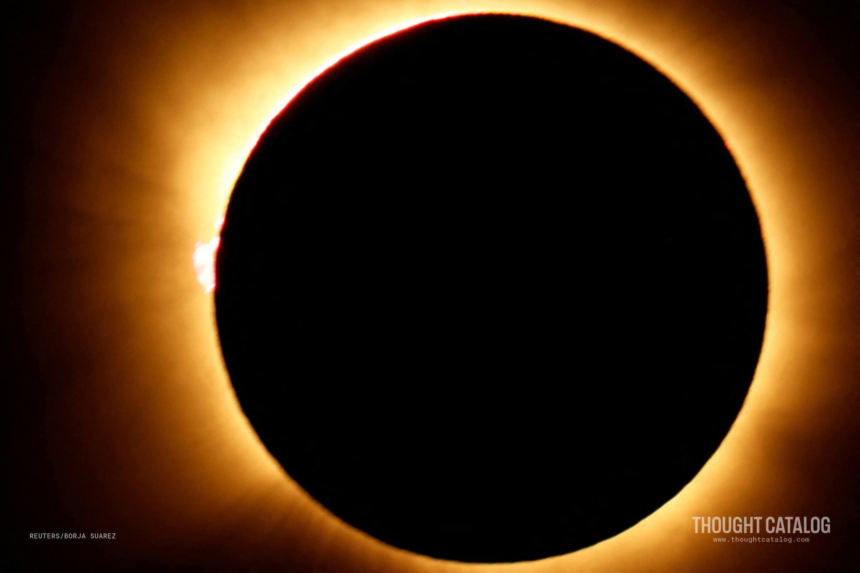
A rare total solar eclipse swept across parts of the Northern Hemisphere on Wednesday, August 12, plunging sections of Greenland, Iceland, northern Russia and Spain into darkness, while millions of people across Europe and parts of Africa witnessed a partial eclipse.
The eclipse was the first total solar eclipse visible from mainland Western Europe since 1999, with the Moon passing directly between the Earth and the Sun and completely blocking the Sun for observers within the narrow path of totality.
Africa did experience the eclipse — but not totality.
According to NASA, the Moon’s penumbral shadow extended into northwestern Africa, where observers could see the Sun partially obscured. The continent was outside the narrow path where the Moon completely covers the Sun.
The distinction is important because a solar eclipse can be visible in different forms depending on an observer’s location. Inside the path of totality, the Moon completely covers the Sun. Outside it, observers see only part of the Sun disappear.
The August 12 eclipse began its journey in the far northern regions of Siberia before crossing the Arctic and North Atlantic oceans, western Iceland and northern Spain. A small part of Portugal also fell within the path of totality.
In Spain, the eclipse produced one of the most dramatic spectacles, with the Moon’s shadow crossing the country and turning daytime skies dramatically darker. In Iceland, Greenland and northern Russia, observers also experienced totality.
NASA said the wider partial eclipse was visible across Europe, Africa, North America and surrounding oceans, making the event observable by a much larger population than those who experienced totality.
Why Africa saw only a partial eclipse
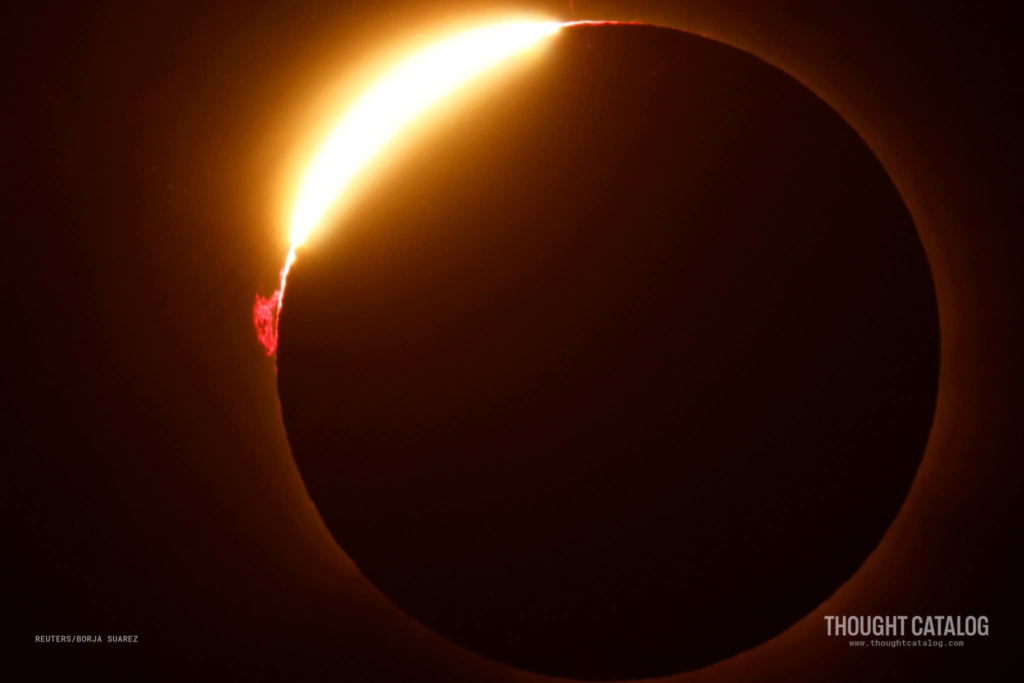
The Moon’s umbral shadow — the part responsible for totality — followed a relatively narrow track across the Northern Hemisphere. Africa lay largely outside this track.
NASA’s eclipse calculations show that the totality path did not extend into Africa. Instead, the continent’s northwestern portion fell within the broader penumbral shadow, allowing the Moon to cover only part of the Sun.
This meant that countries in northwestern Africa could witness the Moon taking a bite out of the Sun, but they could not experience the brief period of complete darkness associated with totality.
For much of sub-Saharan Africa, including Uganda, the August 12 eclipse was not visible because the Moon’s shadow did not extend far enough south.
A rare astronomical spectacle
A total solar eclipse occurs when the Moon passes between the Sun and Earth and appears large enough in the sky to completely cover the Sun’s bright disk.
During totality, the normally hidden solar corona becomes visible around the darkened Moon. The sudden disappearance of direct sunlight can also produce a dramatic drop in daylight and temperature.
The 2026 eclipse had a maximum totality of a little over two minutes, according to NASA’s eclipse calculations.
The event also attracted millions of observers and eclipse chasers, with reports estimating that nearly one billion people could experience at least a partial eclipse, while only about 15 million were located within the path of totality.
Africa’s next major opportunities
Africa will not have to wait long for another significant solar eclipse.
NASA lists an annular solar eclipse on February 6, 2027, which will be visible across parts of Africa including Côte d’Ivoire, Ghana, Togo, Benin and Nigeria, among other regions. An annular eclipse occurs when the Moon passes in front of the Sun but appears slightly too small to completely cover it, leaving a bright “ring of fire” around the Moon.
Even more significant for Africa will be the total solar eclipse of August 2, 2027. Its path of totality will cross parts of North Africa, including Morocco, Algeria, Tunisia, Libya and Egypt, before continuing through the Middle East.
For Uganda and much of East Africa, however, the August 12, 2026 eclipse was not a total-eclipse event. The spectacular darkness witnessed in Spain, Iceland and other parts of the totality path remained a Northern Hemisphere phenomenon, while only northwestern parts of Africa caught a partial view.
In short: yes, the 2026 eclipse touched Africa — but only as a partial eclipse, not as a total eclipse.