



There are moments in journalism when you discover that the most important story is not the one you were sent to cover.
Sometimes the story is the story.
And sometimes the story is sitting quietly in your pocket, wrapped in an envelope, while you are trying to calculate whether it is enough to get you home.
This was one of those moments.
Kololo Independence Grounds has played host to many grand national milestones, but few spectacles match the quiet, existential tragedy of a journalist receiving a Stanbic Bank mobile money notification, glancing at the figures, and briefly convincing themselves that all is well.
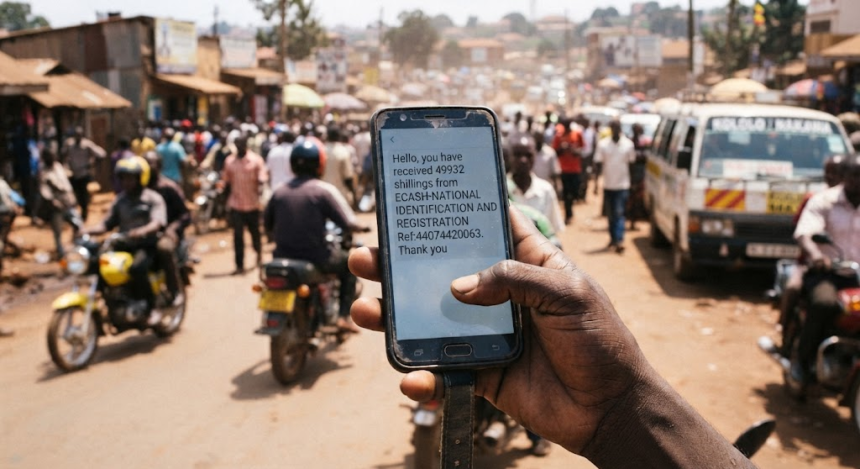
The message from Stanbic Bank was very clear:
“Hello, you have received 49932 shillings from ECASH-NATIONAL IDENTIFICATION AND REGISTRATION Ref:44074420063. Thank you.”
Thank you.
That last part is important.
Because after receiving Shs49,932 for three days of covering a national symposium, one is left wondering who exactly is thanking whom. Actually, the sender expects you to be grateful.
The National Identification and Registration Authority (NIRA) had invited journalists to cover its first-ever My Identity Expo & Symposium, held from September 29 to October 1, 2026, at the Kololo Independence (Ceremonial) Grounds in Kampala.
Three days.
A national symposium.
Speakers.
Panels.
Exhibitions.
Government officials.
Public relations officers.
Press releases.
Story links.
And, eventually, mathematics.
Because the money that landed on some journalists’ phones was Shs49,932.
Not Shs50,000.
Not even the psychologically comforting Shs49,999.
Shs49,932.
At roughly Shs16,644 per day, the journalist had to ask himself a very important question:
Who can afford to get home?
This was not a philosophical question.
It was arithmetic.
Three days at Kololo. Long hours. No breakfast. No lunch. No dinner. Transport to and from the venue. Phone calls. Internet bundles. Writing. Filing. Chasing speakers. Editing photographs. Sending links. Following up.
Then came the great revelation.
Shs49,932.
For the three-day engagement.
Approximately Shs16,000 per day.
Sixteen thousand.
The figure is so small that one almost feels obliged to respect it for its audacity.
And if one gets home, how does one get back to the internet?
Because the journalist has to file the story.
And the story requires data.
And data requires money.
And the boda-boda rider, unfortunately, has not yet reached that advanced stage of civilisation where he accepts press releases as legal tender.
The Mathematics of My Identity
Let us not be unfair.
Perhaps the organisers were testing us.
After all, this was an identity symposium.
Maybe the journalists were supposed to discover their true selves through hardship.
Perhaps somewhere between the third PowerPoint presentation and the fifteenth speech about national identification, a reporter was expected to experience an existential awakening:
I am a journalist.
I am hungry.
I am at Kololo.
I have Shs16,000.
I need to get home.
I also need data.
Who am I?
Now that is an identity crisis.
Any A-Level old-timer who survived Sub-Maths or Pure Mathematics knows the chapter on approximations, errors and limits of accuracy.
J.K. Backhouse.
Those three words are enough to transport an entire generation of Ugandan students back into a classroom where numbers were no longer numbers but threats.
You were taught about absolute error.
Relative error.
Percentage error.
Limits of accuracy.
Significant figures.
And then there was NIRA.
If you ran J.K. Backhouse formulas on NIRA’s arithmetic, the margin of error would probably break the universe.
Consider the evidence.
NIRA officially launched and announced the symposium on Monday, September 7, 2026.
Journalists who attended the launch were facilitated Shs100,000.
So when the same journalists were later invited to a three-day symposium, one reasonable calculation was that the daily rate would at least remain somewhere in the neighbourhood of the launch rate.
At Shs100,000 per day, three days would give you:
Shs300,000.
That is the conservative calculation.
But perhaps the symposium was more demanding.
Perhaps three days of covering exhibitions, speeches, interviews, panels and producing stories deserved an additional Shs50,000 per day.
Then:
Shs150,000 × 3 = Shs450,000.
That is the argument.
Not some journalist’s wild fantasy.
Just Shs150,000 per day for three days.
And then there was the actual message:
“…Shs49,932. Thank you.”
The number that made several journalists suddenly rediscover Sub-Maths.
One colleague actually told me what happened to him.
He had attended the launch.
He had received Shs100,000.
So when the symposium came, he had mentally placed the facilitation somewhere between Shs150,000 and Shs200,000 per day.
He was not calculating his retirement.
He was simply doing arithmetic.
Three days at Shs200,000 would be Shs600,000.
Three days at Shs150,000 would be Shs450,000.
So when the Stanbic message came through showing 49932, his brain performed a beautiful but catastrophic approximation.
He read it as Shs499,000.
Immediately, his mind went to work.
A pending debt could finally be paid.
He could clear this.
He could breathe.
Perhaps he had even been underpaid by Shs100,000.
He rushed to the mobile money agent.
“Withdraw Shs480,000.”
The agent tried.
Insufficient funds.
He tried Shs475,000.
Again:
Insufficient funds.
At this point, mathematics had become personal.
So he went back to the message.
And counted the figures.
One.
Two.
Three.
Four.
Five.
That was when the symposium ended.
Not politically.
Not institutionally.
Mathematically.
He realised that what he had received was not Shs499,000.
It wasn’t even Shs50,000.
It was Shs49,932.
The man had not miscalculated his money.
He had miscalculated the number of zeros.
That is the kind of error Backhouse never adequately prepared us for.
The symposium had just taught the journalist another lesson in approximation:
Sometimes the difference between 49,932 and 499,000 is not a rounding error.
It is a whole financial ecosystem.
The calculator develops malaria when the budget reaches media.
The Great Ugandan Media Miracle
There is another miracle that happens at events in Uganda.
Institutions somehow manage to budget for everything except the journalists who will tell the public that the event happened.
Venue?
Budgeted.
Stage?
Budgeted.
Sound system?
Budgeted.
Branding?
Budgeted.
Screens?
Budgeted.
VIP chairs?
Budgeted.
Decorations?
Budgeted.
Guest refreshments?
Budgeted.
Security?
Budgeted.
Transport for important people?
Budgeted.
Then somebody reaches the line marked media.
Suddenly the calculator develops malaria.
The budget becomes shy.
The accountant clears his throat.
Media will manage.
The journalist will arrive by photosynthesis.
The camera will run on patriotism.
The laptop will charge itself.
The phone will somehow manufacture data.
And the internet?
The internet will come from the Holy Spirit.
What about lunch?
Well, lunch is where the national identity system becomes particularly interesting.
First of all, how do you budget for an event without budgeting properly for the media that will publicise the event?
How do you spend money making sure people know about the event and then treat the people producing that publicity as an unexpected expense?
It is like building a house and remembering the roof after the housewarming.
Or buying a microphone and discovering on the day of the concert that nobody budgeted for electricity.
The media is not a decorative flower placed beside the podium.
Journalists are workers.
They travel.
They sit through proceedings.
They interview people.
They record.
They write.
They edit.
They transmit.
They publish.
And sometimes they do all of that while wondering whether they have enough money left to get home.
If the objective is visibility, why is the visibility team treated like an invisible other?
Please Identify Yourself
And this is where My Identity becomes almost too perfect a theme for satire.
NIRA’s mandate revolves around identity.
Registration.
Recognition.
Citizenship.
Identification.
Data.
The National Identification Number.
Knowing who you are.
Being counted.
Being recognised.
So when journalists arrived at the symposium, naturally, we were asked to register.
Name.
Organisation.
Contact.
Signature.
Attendance.
Everything.
We identified ourselves.
We registered ourselves.
We confirmed that we had arrived.
We did exactly what the symposium was encouraging the country to do.
Please identify yourself.
We did.
Then lunchtime came.
And suddenly our identities became complicated.
How did our names disappear from the lunch list when they had just been captured on the attendance register?
How does a journalist exist in the registration database at 9 a.m. and become an undocumented person at 1 p.m.?
The people who had welcomed us in the morning appeared to develop a temporary case of facial blindness.
The same people who had been offering seats, directions and polite smiles now seemed unable to recognise journalists who had signed in that very morning.
This is where the comedy becomes almost philosophical.
Was the registration database not synchronised with the lunch database?
Was there a technical glitch?
Did my identity become invalid between the opening remarks and the buffet?
Perhaps NIRA needs to introduce another identification number:
NLIN — National Lunch Identification Number.
Because apparently having a name, an organisation, an invitation and a confirmed attendance does not necessarily make you an invited guest when the lunch coupons arrive.
The Republic of the Empty Chair
But food is not the only place where the journalist becomes invisible.
Sometimes you are not even given a table.
You are expected to stand somewhere.
Usually at the back.
Sometimes in a corner.
Sometimes beside a wall.
Sometimes behind a pillar from which you can photograph the back of the guest of honour’s head and call it coverage.
And if there are not enough seats?
Guess who moves?
The journalist.
Because apparently we are important enough to be invited but not important enough to remain seated.
This is a remarkable category of human being:
The Invited but Displaceable Guest.
You are invited.
You confirm attendance.
You arrive.
You register.
You sit.
Then someone more important arrives.
And suddenly:
“Journalists, please move to the back.”
The journalist picks up the notebook.
Picks up the recorder.
Picks up the camera.
Picks up the dignity.
And moves.
Nobody says:
“We had poor planning. We should find another solution.”
No.
The media becomes the emergency seating reserve.
When the room is full, journalists are the expandable furniture.
And this is not merely a NIRA problem.
It is an industry habit.
At some events, journalists are treated as though their natural habitat is the floor.
Give the VIP a chair.
Give the guest a chair.
Give the sponsor a chair.
Give the politician a chair.
Give the permanent secretary a chair.
Give the person who arrived 45 minutes late a chair.
The journalist?
Please stand somewhere at the back.
After all, the journalist is going to write about the event.
He does not need to see it properly.
Apparently.
The Lunch-Coupon Republic
The morning usually begins beautifully.
“Please come and cover our event.”
“Please confirm your attendance for better planning purposes.”
“Kindly confirm.”
“Please let us know if you will attend.”
“Your presence will be highly appreciated.”
The journalist confirms.
The journalist travels.
The journalist registers.
The journalist sits through speeches.
The journalist takes notes.
The journalist records interviews.
The journalist takes photographs.
The journalist asks questions.
The journalist works.
Then lunchtime approaches.
And something extraordinary happens.
The people who were saying “please” in the morning suddenly stop saying anything.
The lunch coupons have developed legs.
The same people who were offering you front-row seats hours earlier suddenly look straight through you.
“Invited guests only.”
But we too were invited.
With pleas.
With polite phone calls.
With messages.
With requests to confirm attendance “for better planning purposes.”
So what exactly happened to the planning?
Was the journalist included in the attendance planning but excluded from the lunch planning?
Was the invitation valid only until the buffet opened?
Perhaps the official wording should have been:
“Please come and cover our event. Kindly confirm attendance for better planning purposes. Lunch subject to your continued existence as an invited guest.”
That sudden tactical amnesia at lunchtime is one of the great mysteries of event management.
You can be remembered perfectly at 9 a.m.
Forgotten at 1 p.m.
And resurrected at 7 p.m.
Which brings us to another miracle.
The Midnight Resurrection of the PR Handler
Until, of course, the sun goes down.
Suddenly, the ghost vanishes, and the phone resurrects.
The moment it is time to report back to their bosses, your WhatsApp lights up.
“Hi, kindly share the link for the story.”
Then:
“Please send the link once published.”
Then:
“Kindly share the stories.”
Then:
“Good evening, kindly share links for our report.”
The journalist who was invisible at lunch has become extremely important at 8:47 p.m.
This is perhaps the most efficient resurrection system in Uganda.
At lunch:
Who are you?
At 8 p.m.:
Kindly share the link.
The journalist has gone from an uninvited guest to a key performance indicator in approximately eight hours.
The same communications officer who could not find your name on the lunch list can find your WhatsApp number with the precision of a forensic investigator.
The sudden tactical amnesia at lunchtime is matched only by the extraordinary memory at reporting time.
They remember your number.
They remember your organisation.
They remember your face.
They remember exactly what story you promised.
They remember that the Permanent Secretary said something at 11:43 a.m.
They remember that you interviewed the ED.
They remember that you were sitting in the third row.
They remember everything.
Except lunch.
This is the ultimate insult.
You are treated as an invisible ghost during the event, only to be summoned back to life the second a link is needed for an accountability report.
The Journalist as National Infrastructure
This is where the joke stops being entirely funny.
Because journalists are not merely attendees.
They are workers.
And journalism is not free.
Transport costs money.
Internet costs money.
Food costs money.
Equipment costs money.
Electricity costs money.
Time costs money.
The actual labour of reporting costs money.
They are collecting information, interviewing people, writing, editing, photographing, recording, transmitting and publishing.
And many are doing all of this using their own phones, their own laptops, their own transport and their own internet.
A journalist can spend the entire day producing publicity for an institution and still have to borrow data to send the publicity back to the institution.
Think about that.
You are covering an event whose purpose is visibility.
You spend your own money to create the visibility.
Then the institution calls you to ask for the link proving that you created the visibility.
It is almost a circular economy.
Except the journalist is the central bank.
And the central bank has no money.
Yet the media is often treated as though journalists should be grateful merely to have been allowed through the gate.
This is the strange social contract:
The institution needs publicity.
The journalist needs access.
The institution knows it needs the journalist.
The journalist knows he needs the access.
And somewhere in the middle, the journalist is expected to absorb the cost of producing the publicity.
That is why the Shs49,932 matters.
It is not merely about money.
The money becomes a measuring instrument.
It tells you something about how an institution values the labour it expects from the media.
The journalist knows exactly what he is worth.
He just cannot afford to say it aloud.
The Borrowed Data Bundle
Imagine leaving Kololo with roughly Shs16,644 for the day.
You now have a series of choices.
Spend the money on a boda-boda and arrive home with nothing for data.
Or walk home and preserve the money for a data bundle.
Or borrow money.
Or borrow data.
Or call a colleague.
“Boss, please hotspot me.”
Because the journalist still has to file.
The institution has held a three-day symposium.
The journalist has to produce three days of publicity.
The story has to be written.
The photographs have to be uploaded.
The video has to be sent.
The editor needs the copy.
And the PR department will eventually need the link.
So the journalist is effectively being asked to finance the publicity campaign from his own pocket.
Maybe NIRA could call this:
My Identity: The Journalist Edition.
Subtitle:
My NIN, My Phone, My Data Bundle, My Transport.
Or perhaps:
My Identity, My Shadow, Never Apart.
Except the journalist’s shadow has to pay its own transport.
The Blank-Sheet Heist
And here is where the story becomes more uncomfortable.
Because the issue is not always simply that a journalist received little money.
The bigger question is:
Where was the money that was supposed to facilitate the media?
Across government agencies, NGOs, companies and private institutions, journalists have heard enough stories about communication budgets to know that the amount requested from the boss and the amount eventually reaching the journalist can sometimes look like two different mathematical problems.
The allegation is familiar.
A communications or PR department requests a substantial budget for media facilitation.
The budget is approved.
The money is released.
The journalist arrives.
Then comes the attendance sheet.
“Please sign here for accountability purposes.”
The journalist signs.
The amount column is blank.
He leaves.
Later, the amount can be filled in.
And because the journalist has already gone, who is there to prove what he actually received?
The journalist’s signature remains.
The money becomes a mystery.
The paperwork looks complete.
Everybody has apparently been paid.
The attendance sheet is beautifully filled.
The accountant is satisfied.
The boss is satisfied.
The file is closed.
Only the journalist is standing outside wondering whether the amount on the paper and the amount in his pocket have ever met.
That is the blank-sheet problem.
And it raises a simple question:
If I sign to confirm that I attended, why am I also signing a document that does not yet state what I received?
What exactly am I authenticating?
My attendance?
Or somebody else’s future arithmetic?
A blank amount column is a very interesting accounting instrument.
It allows reality to be completed later.
The journalist leaves with Shs50,000.
The paperwork can apparently develop a different memory.
And there is no witness.
No second signature.
No journalist sitting in the room when the amount is entered.
Just the beautiful administrative sentence:
“For accountability purposes.”
Sometimes the most dangerous words in bureaucracy are the most innocent-sounding ones.
Government Has Money
The irony becomes sharper when placed beside the words of Internal Affairs Minister Prof Ephraim Kamuntu during the symposium.
The minister made a broader point about government resources and institutional priorities.
“Government has money,” he said.
Then:
“Government has a lot of money.”
His point was that the issue was how institutions manage, network, plan and make their case for resources.
That statement deserves to sit beside the Shs49,932 message for a moment.
Because nobody is asking NIRA to fund journalists’ mortgages.
Nobody is demanding champagne at Kololo.
Nobody is asking for a presidential motorcade.
We are talking about basic transport and sustenance for people who have been summoned to spend several days producing content about the institution.
Because perhaps the problem is not that Uganda has no money.
Perhaps the problem is what happens between the budget and the person holding the microphone.
Government has money.
Events have money.
Budgets have money.
Communication departments have money.
Public relations has money.
The question is:
Does the money reach the person doing the communicating?
Because you can have the most sophisticated national identity system in the country, but if the person publicising it has to borrow data to upload the story, there is something wonderfully primitive about the sophistication.
And then the journalist writes:
NIRA Hosts My Identity Expo and Symposium.
He writes another:
Minister Calls for 100% Identification of Ugandans.
Then another:
Government Has Money, Minister Tells NIRA.
That third headline practically writes itself.
The irony is so complete that it almost becomes performance art.
The institution has just spent three days explaining why identification is foundational to national development.
The journalist returns home and discovers that his own professional existence is founded on borrowed data.
This is not merely irony.
This is Uganda.
Perhaps Prof Kamuntu should be invited to the next media budgeting meeting.
Not to give a speech.
Just to sit quietly in the room.
When someone says, “We don’t have money for journalists,” he can raise his hand.
“Government has money.”
When someone says, “We can only facilitate them with Shs49,932,” he can raise his hand again.
“Government is not broke.”
When someone says, “The budget is constrained,” he can ask the question he himself put to NIRA:
How did you plan?
Because this is the uncomfortable question.
Why is the journalist always the easiest person to remove from the budget?
Why can the venue not be downgraded before the people producing the publicity are downgraded?
Why is branding treated as an essential expense while the people carrying the message are treated as an inconvenience?
Why budget carefully for almost everything except the labour they depend upon to communicate?
And why have journalists themselves become so embarrassed to ask?
Perhaps because we have been trained to behave as if asking for basic professional costs is begging.
Perhaps because every newsroom has a story about a journalist who complained and was quietly removed from the invitation list.
Maybe the Journalist Should Also Register
Perhaps NIRA needs one more registration service.
Not another biometric system.
Not another registration centre.
Not another National Identification Number.
A special category for journalists.
NIN — Nationally Invisible Newsworker.
Every journalist gets a number.
You register when you arrive.
Your identity is verified.
Your attendance is captured.
Your facilitation is entered.
Your lunch coupon is generated.
Your seat is reserved.
Your transport is recognised.
Your data bundle is validated.
And when the PR officer sends:
“Kindly share the link.”
The system responds:
“Kindly first confirm the journalist’s lunch.”
Now that would be digital transformation.
Perhaps it could even send another automatic notification:
“Dear journalist, your seat has been revoked because an important guest has arrived.”
Then, at 8 p.m.:
“Your identity has been restored. Kindly share the story link.”
The Real Error
The real error here is not Shs49,932.
The real error is the assumption that journalism is somehow free.
It is not.
The journalist is not a decorative accessory placed beside the podium.
The journalist is part of the machinery that makes public communication work.
Yet there is a strange hierarchy at many events.
The journalist is important enough to be invited.
Important enough to be called repeatedly.
Important enough to be asked to confirm attendance.
Important enough to be asked for stories.
Important enough to be asked for photographs.
Important enough to be asked for links.
But not important enough to keep a chair when the room fills up.
Not important enough for lunch.
Not important enough for proper facilitation.
Not important enough to have the amount written before signing.
Not important enough for anyone to wonder how he will get home.
Don’t complain too loudly.
Because you may not be invited next time.
That sentence has probably shaped more newsroom behaviour than any journalism textbook.
“Don’t make noise.”
“They won’t invite us again.”
“Just take what they give you.”
“Leave it.”
“Maybe next time.”
And so the journalist goes home.
He writes the story.
He sends the link.
He smiles.
And the system learns nothing.
Until the link is needed.
Then suddenly:
Very important.
So It Doesn’t Come From Me
This is probably the most absurd part.
Ask journalists privately about poor facilitation, blank attendance sheets, missing meals, disappearing seats, delayed payments and communication budgets.
You will hear stories.
Lots of them.
Ask the same journalists publicly.
Silence.
Why?
Because everyone knows the ecosystem.
The reporter who complains today may need an invitation tomorrow.
The journalist who asks why there is no lunch may be labelled difficult.
The journalist who asks where the media budget went may suddenly stop appearing on the media list.
The newsroom that makes too much noise may stop receiving invitations.
So the conversation becomes:
“Someone should say something.”
But nobody wants to be the someone.
“So it doesn’t come from me.”
Tell the story.
But don’t say I told you.
Complain.
But don’t quote me.
Expose the practice.
But leave my name out.
It is how an entire industry can know something is wrong and still collectively pretend it is normal.
And that is where satire becomes useful.
Sometimes the comedian can say what the journalist cannot.
Sometimes the joke can carry the uncomfortable truth across the room without asking permission.
The Final Identification
NIRA’s symposium was about identity.
Who are we?
Who belongs?
Who is recognised?
Who is counted?
Who is visible?
Those are serious national questions.
But perhaps there is another question hiding underneath all of them:
Who counts the people doing the counting?
The journalist registered.
The journalist attended.
The journalist worked.
The journalist stood when there was no seat.
The journalist moved when an important guest arrived.
The journalist searched for lunch when the coupons disappeared.
The journalist borrowed data.
The journalist found transport.
The journalist wrote.
The journalist published.
The journalist was asked for the link.
The journalist was identified when publicity was needed.
And somehow, between the registration desk and the lunch table, his identity disappeared.
Then, at the end of it all, Shs49,932 appeared on his phone.
That amount may look small.
But it is large enough to teach an entire masterclass.
It teaches arithmetic.
It teaches budgeting.
It teaches approximations.
It teaches tactical amnesia.
It teaches disappearing lunch coupons.
It teaches emergency seating arrangements.
It teaches the strange art of moving journalists to the back so that “important guests” can sit in front.
It teaches the economics of journalism.
It teaches the politics of access.
It teaches the relationship between public relations and the people hired—implicitly or explicitly—to make public relations possible.
And perhaps most importantly, it teaches us about visibility.
The journalist is invisible when the chairs run out.
Invisible when lunch is served.
Invisible when budgets are divided.
Invisible when facilitation is discussed.
Invisible when the amount column is left blank.
Invisible when everyone is asked to move so that someone more important can sit.
Then the phone vibrates.
“Hi, kindly share the link for the story.”
Suddenly, the journalist exists.
Suddenly, his identity is recognised.
Suddenly, everybody knows exactly who he is.
So perhaps the real NIRA symposium was not simply about My Identity.
Perhaps it was also an accidental masterclass in who gets to be visible in Uganda—and when.
And if J.K. Backhouse were still standing in front of an A-Level class, perhaps he would write one final question on the blackboard:
If a three-day national symposium is worth Shs49,932 to the person who spends three days making sure the public knows it happened, what exactly is the margin of error?
Calculate carefully.
There may be no correct answer.
Because some errors are mathematical.
Others are institutional.
And some are simply what happens when everybody knows the number is wrong, but nobody wants to be the first person to say so.
Especially when there is another invitation coming next month.
So, for the record, this is not coming from me.
It is simply a small problem of identity.

