


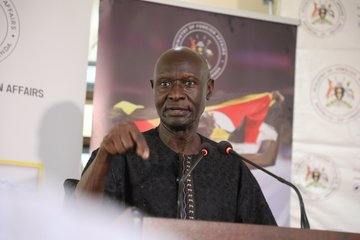
KAMPALA — Ambassador Olara Otunnu has pledged to reform and revitalise the United Nations if elected Secretary-General, promising to restore the moral authority of the office, strengthen peace efforts and make the global body more responsive to the challenges facing humanity.
Otunnu made the remarks on Wednesday while addressing journalists at the Ministry of Foreign Affairs headquarters in Kampala, shortly after Uganda officially presented his candidature for the UN’s top position.
The Ministry of Foreign Affairs said Uganda’s nomination of Otunnu reflects the country’s commitment to effective, inclusive and responsive multilateralism.
“The next Secretary-General must restore and strengthen the moral authority of the office through dialogue, consensus-building and principled leadership,” Otunnu said.
The former UN Under-Secretary-General said his candidature is based on an agenda focused on peace and security, human rights, sustainable development, climate action, responsible artificial intelligence governance and development financing.
“The Secretary-General serves the peoples of the world. The challenges of peace, development, climate change, technology and human dignity are collective concerns that require collective solutions,” he said.
Restoring UN Moral Authority
Otunnu said the Secretary-General’s office is unique because its influence does not come from military power, financial resources or direct political authority, but from the moral legitimacy provided by the UN Charter.
“The Secretary-General of the United Nations has something else — moral authority. That moral authority flows directly from the principles of the UN Charter and from the collective membership of the United Nations and the peoples of the world,” he said.
He argued that the authority of the office has weakened over time and requires deliberate action to restore confidence in the United Nations.
“The Secretary-General must use that moral authority carefully and courageously to lead the United Nations. That authority has not disappeared, but it has been eroded,” Otunnu said.
UN Reform Central to Agenda
Otunnu said reforming the United Nations would be one of his key priorities, including making global institutions more representative and improving internal efficiency.
He pointed to ongoing discussions on reforming the UN Security Council, saying the structure of global governance must reflect present-day realities.
“There is the ongoing debate about making the Security Council more representative of today’s world. That discussion must continue and hopefully reach a successful conclusion,” he said.
He also called for reforms within the UN bureaucracy to ensure the organisation delivers effectively for member states and ordinary people.
“The UN must become an organisation that reflects the aspirations of its members and the people it serves. It must be efficient, effective and responsive,” Otunnu said.
Peace and Security Remain Key Priority
Otunnu identified peace and security as the foundation of the United Nations, saying the organisation must strengthen conflict prevention, mediation and peace-building.
“The central foundation of the UN is conflict prevention, conflict resolution and peace-building. The peace and security role of the United Nations remains its most important responsibility,” he said.
He said the next Secretary-General must engage global powers and other stakeholders to address conflicts with wider geopolitical implications.
Otunnu also highlighted the impact of conflicts on vulnerable groups, particularly women and children.
“The United Nations cannot be indifferent. It must lead efforts to reduce the impact of conflicts on vulnerable communities and ensure that programmes are available for the rehabilitation and recovery of women and children affected by war,” he said.
Global Rules Needed for Artificial Intelligence
The former UN official said artificial intelligence presents both opportunities and risks, warning that humanity must develop a global framework to guide its use.
“We are entering another transformation that may dwarf all previous ones: the impact of artificial intelligence,” he said.
Otunnu said the UN should help establish international standards, values and mechanisms to ensure AI benefits humanity while preventing misuse.
“The young man under the mango tree in Katwe, the creative young man and the creative young woman everywhere, must also be part of this technological future,” he said.
He stressed the importance of equitable access to technology, saying AI should not become a tool available only to a few countries or groups.
Climate Change and Development Financing
Otunnu said climate change has become a global challenge requiring cooperation between developed and developing countries.
“No part of the world is now untouched by the effects of climate change,” he said.
He called for solutions that allow countries to pursue development while protecting the environment.
“Climate action should not be seen as a competition between developed and developing countries. We must find win-win solutions that benefit all humanity,” he said.
On development financing, Otunnu said many developing countries have clear development priorities but lack affordable long-term financing.
He said the Secretary-General can use the influence of the office to mobilise international partnerships.
“The moral authority of the Secretary-General can be used to bring together partners and ensure that developing countries that are doing the right things have access to the resources needed for transformation,” he said.
Bridging the Global and Local Divide
Otunnu said the United Nations must avoid becoming detached from ordinary people and should strengthen links between international decisions and local realities.
“The United Nations must not become a diplomatic ivory tower. There must be a connection between the global and the local, and between the local and the global,” he said.
He cited his own career journey — from Uganda to international diplomacy and back to grassroots engagement — as evidence of his ability to bridge different levels of leadership.
Otunnu has previously served as Uganda’s Ambassador to the United Nations, President of the UN Commission on Human Rights and UN Under-Secretary-General and Special Representative for Children and Armed Conflict.
Uganda Says Otunnu Has Credentials to Lead UN
The Permanent Secretary at the Ministry of Foreign Affairs, Vincent Bagiire, said Uganda believes it has a strong case for the UN Secretary-General position because of its contribution to international diplomacy and peacekeeping.
Bagiire cited Uganda’s previous leadership of UN institutions, including former Foreign Affairs Minister Sam Kutesa’s tenure as President of the UN General Assembly in 2014–2015.
He also highlighted Uganda’s role in regional peace efforts, including its deployment of troops to Somalia since 2007 and participation in security operations in the Democratic Republic of Congo.
Uganda formally nominated Otunnu for the position on July 24, 2026. The selection process requires recommendation by the UN Security Council before appointment by the General Assembly.
Otunnu joins a competitive field of candidates seeking to succeed the current UN Secretary-General, with Uganda now beginning diplomatic engagements to build support among member states.

