



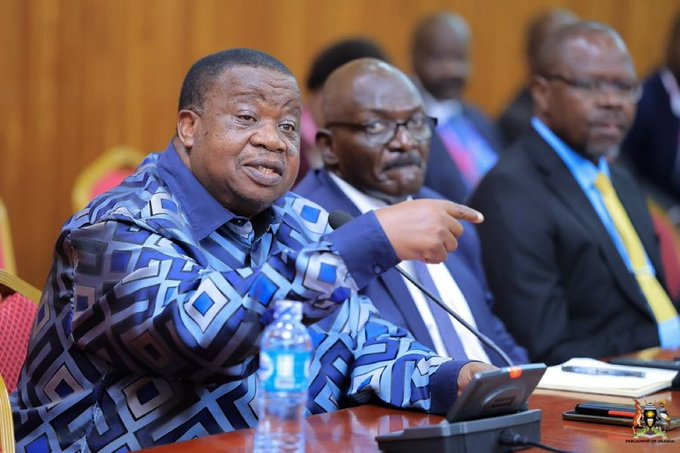
Former Internal Affairs Minister Maj Gen Kahinda Otafiire and former Works and Transport Minister Gen (Rtd) Edward Katumba Wamala have given conflicting accounts of Uganda’s digital number plate project, with both raising questions about how the police and the contractor’s systems worked together.
Appearing before Parliament’s Committee on Physical Infrastructure on Tuesday, October 13, Otafiire said the police system did not interact with that of Joint Stock Company Global Security, the Russian contractor behind the Intelligent Transport Monitoring System (ITMS).
“The police does not interact with Joint Stock, at least when I was still there. So the two were crashing,” Otafiire told MPs.
Otafiire, who is now the Minister of Water and Environment, questioned the effectiveness of the US$25 million (about Shs90 billion) project, saying the technology appeared to offer little improvement over systems already available to the police.
He said he had opposed the project because the Russian technology was incompatible with the Chinese technology used in Uganda’s existing police camera network.
Otafiire also questioned whether the system could reliably track a vehicle independently of its number plate or tracking device.
He told MPs that, during a test, number plates were removed from a vehicle and taken to his office on Jinja Road while the vehicle remained in Kololo. However, the system continued to indicate that the vehicle was in Kololo.
According to Otafiire, the test raised questions about whether the system tracked the actual vehicle or merely the device installed in it.
“So what they are selling to us is a tracking system. That is all,” he said.
Katumba cites presidential directive
Katumba, who served as Works and Transport Minister and is now Minister of Public Service, told the committee that the project followed President Yoweri Kaguta Museveni’s directive for government agencies to use a shared system.
He said the digital number plates were intended to improve vehicle monitoring and help security agencies investigate crime.
However, Katumba acknowledged that the police and Joint Stock systems did not interact during his tenure, creating operational conflicts.
He also told MPs that the ministry had implemented the project without conducting a preliminary feasibility study.
Katumba defended the importance of vehicle-tracking technology, citing his personal experience following the 2021 gun attack against him. He said police used tracking and surveillance capabilities to identify suspects who were later brought before court.
“So for me, I am a beneficiary of the system which the police is operating,” he said.
He cautioned, however, that he could not confirm whether improvements introduced by Global Security were directly connected to the system that helped police investigate the attack.
The conflicting accounts have raised further questions about whether the government adequately assessed the compatibility, cost and effectiveness of the technology before implementing the project.
Parliament is also examining the costs imposed on motorists, the contractor’s role and a proposed additional investment of US$158 million to address weaknesses in the original project.

