



KAMPALA — A student at Makerere University has developed an innovative disposable device that allows women to urinate while standing, offering a practical solution aimed at improving hygiene, comfort, and convenience in public spaces.
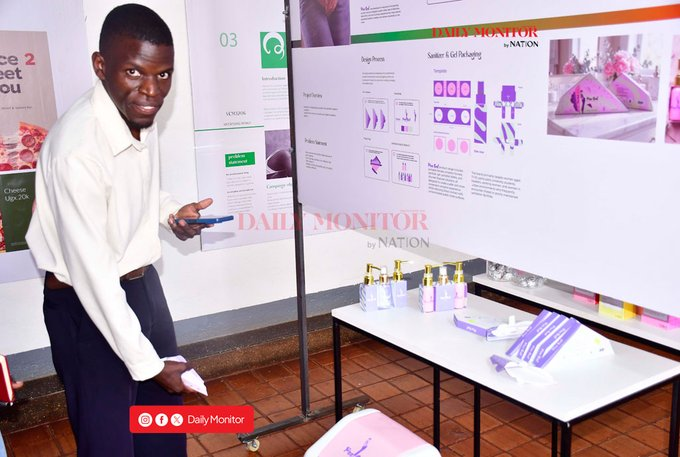
The invention, dubbed Pee-Gal, was designed by student innovator David Kaleebu and was recently showcased during a student innovation exhibition at Makerere University’s Margaret Trowell School of Industrial and Fine Arts.
According to Kaleebu, the idea was inspired by challenges many women face when using public toilets, particularly elderly women who struggle to squat and those concerned about hygiene in shared sanitation facilities.
“You realize that most old women cannot squat to urinate and many young women today complain about urinary tract infections because they have to use public toilets which sometimes are not clean,” Kaleebu said while presenting the innovation.
The disposable device is made from flexible paper and functions as a funnel that directs urine away from the body, enabling users to relieve themselves while standing and minimizing contact with potentially unsanitary toilet surfaces. Each package reportedly contains 15 disposable funnels, along with sanitizer, gel, and lotion to support personal hygiene after use.
The innovation comes at a time when concerns about sanitation and access to clean public toilets remain widespread, particularly for women who often encounter long queues or unhygienic facilities in markets, transport hubs, schools, and workplaces.
Female urination devices, also known internationally as stand-to-pee devices, have been used in several countries for decades and are designed to help women urinate while standing, particularly in outdoor settings, public events, travel situations, and environments where sanitation is limited.
Dr. Richard Lukenge Kamya, the project lead for the exhibition, said the showcase highlights how student innovation can be applied to address practical social and public health challenges.
“This exhibition showcases capstone projects across diverse design disciplines,” Dr. Kamya said, noting that many of the projects focus on solving everyday problems through creative design and technology.
Pee-Gal was among 64 student projects exhibited at the event, which featured innovations ranging from food preservation technologies and waste management systems to mobile applications for healthcare navigation and student services.
Health advocates say innovations that improve access to safe sanitation can contribute to better public health outcomes, particularly for women who may avoid using public toilets because of cleanliness concerns.
As Uganda continues to encourage innovation and entrepreneurship among university students, Pee-Gal is being viewed as a simple but potentially impactful invention with the capacity to improve women’s health, dignity, and confidence when accessing public sanitation facilities.

