
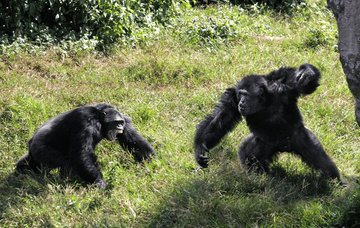

A rare and violent conflict described by scientists as a “civil war” has erupted among chimpanzees in western Uganda, leaving at least 28 animals dead in a prolonged internal conflict.
The civil war is unfolding in Kibale National Park, where researchers have been studying one of the world’s largest known chimpanzee communities—known as the Ngogo group—for more than three decades.
According to recent scientific findings, the once-unified group of about 200 chimpanzees began to fracture around 2015, eventually splitting into two rival factions—commonly referred to as the western and central groups.
What followed was an escalation into sustained, coordinated violence. Researchers documented repeated mafia-style raids, with one faction targeting former group members in lethal ambushes.
By 2026, at least 28 chimpanzees had been killed, with victims including adult males and a significant number of infants.
Scientists say the killings marked a disturbing shift from typical chimpanzee behavior, where violence is usually directed at rival groups rather than within the same community.
The reason behind the split remain unclear, but experts point to a combination of factors including the death of key chimpanzees, competition for food and mates, and possible disease outbreaks that weakened social bonds.
Researchers also noted that the attacks were not random but coordinated, suggesting complex social organization and coalition-building among the animals—traits often associated with human behaviour.
The case is only the second well-documented case of prolonged conflicts among chimpanzees, following the Gombe Chimpanzee War observed by primatologist Jane Goodall in Tanzania in the 1970s.
Conservationists warn that such conflict could further threaten chimpanzee populations, which are already endangered due to habitat loss and human pressures.