



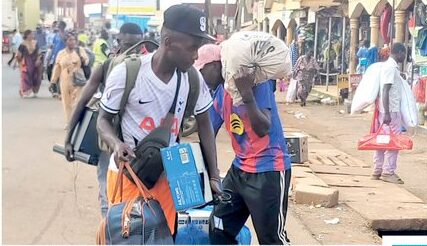
BUSIA — A number of Ugandans affected by Kenya’s new restrictions on non-citizens operating small businesses have begun returning home, with some arriving at the Busia border after the directive took effect on Monday, September 7.
The Ugandans were among foreign traders caught up in President William Ruto’s directive requiring foreigners engaged in small-scale businesses to stop such activities in Kenya.
Images from the Busia border on Monday showed Ugandan nationals arriving from Kenya following the implementation of the directive. Ugandan traders were also reported to have closed businesses amid uncertainty over enforcement.
Ruto announced the measures on September 2 while addressing micro, small and medium enterprise traders at State House in Nairobi. He argued that small-scale trading opportunities should primarily benefit Kenyan citizens.
The directive targets activities such as hawking and other low-capital businesses, which the Kenyan government says have increasingly been taken up by foreign nationals.
Ruto said the government had built investor confidence to attract major investors, not foreigners competing with Kenyans in small-scale trading. “We have not built investor confidence so that hawkers can come to Kenya. The investor confidence we have built is for investors to come to Kenya, not hawkers and traders.”
The directive has affected nationals from several East African countries, including Uganda, Burundi, Tanzania and Rwanda, raising concerns about its implications for regional integration and the East African Community Common Market.
Kenya moves to calm fears
As foreign traders began making arrangements to leave, the Kenyan government moved to clarify that the directive does not amount to a blanket expulsion of East African nationals.
Kenya’s government has opened a temporary registration window for undocumented foreign nationals, allowing them to identify themselves through their respective embassies and regularise their status. Those who register during the period will be presumed to be legally present in Kenya while their documentation is processed.
Kenyan Foreign Affairs officials have also stressed that East Africans remain free to live and work in Kenya provided they comply with immigration, work-permit and business regulations.
The clarification came after scenes of anxiety in Nairobi, where hundreds of Burundians reportedly gathered outside their embassy seeking travel documents, while other foreign nationals made arrangements to leave the country.
What happens to Ugandan traders?
For Ugandans who have built livelihoods in Kenya’s informal economy, however, the distinction between undocumented traders and legally established businesses may offer little immediate comfort.
Some affected Ugandans have already opted to return home rather than risk enforcement or lose their stock and businesses.
The movement through Busia is particularly significant because the Uganda-Kenya border is one of the region’s busiest commercial corridors. Thousands of people and large volumes of goods move through the border every day, linking communities on both sides whose economic and social lives have long crossed the national boundary.
The latest measures have therefore revived an old East African contradiction: the region speaks of integration, free movement and one common market, while individual states continue to protect domestic economic spaces from their neighbours.
Kenya is not the first East African country to impose restrictions on foreign-owned small businesses. Tanzania introduced regulations in 2025 restricting non-citizens, including citizens of other EAC countries, from engaging in a range of small businesses such as retail trade, mobile-money services and salons.
Kenya’s latest action has consequently raised fresh questions about the future of the EAC Common Market, which was designed to facilitate the movement of people, labour, services and capital across member states.
For the Ugandan traders arriving at Busia, however, the regional debate is more immediate.
They are returning with a simple question: if East Africa is one market, who gets to decide where an East African can make a living?