



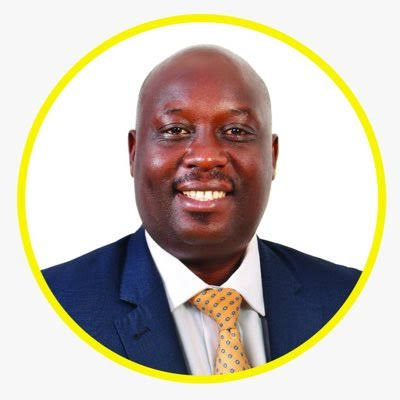
Questions have emerged over the academic qualifications of Mawogola North Member of Parliament Godfrey Aine Kaguta, popularly known as Sodo, following renewed scrutiny of his Uganda Certificate of Education (UCE) and Uganda Advanced Certificate of Education (UACE) results.
The debate centres on whether the examination records attributed to Sodo satisfy the minimum academic qualification required by law for election to Parliament, as well as how he progressed from Ordinary Level to Advanced Level.
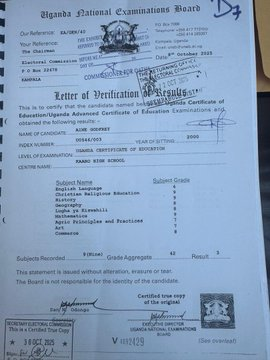
Documents reportedly attributed to the Uganda National Examinations Board (UNEB) indicate that Sodo obtained an aggregate of 42 in his UCE examinations at Kaaro High School, with a Result 3 classification and grades of F9 in English, History, Geography and Christian Religious Education.
His reported UACE results carry a Result 5 classification, with failures in most subjects but one principal pass.
The records have triggered questions on social media, with critics seeking clarification from UNEB on how he qualified to proceed to Advanced Level and whether the results satisfy the requirements for parliamentary office.
Journalist and activist Agather Atuhaire questioned the matter in a post on X on October 19, arguing that the legal requirement for Advanced Level education should be interpreted in the context of actual passes.
“The law says S.6 or its equivalent but I am sure the law makers meant a passed S.6,” Atuhaire wrote, adding that UNEB should explain how a candidate with the reported Ordinary Level results proceeded to Advanced Level and offered a combination containing subjects in which he had reportedly obtained F9 grades.
However, the authenticity and full context of the circulating examination records have not been independently established in the information available, and the reported grades alone do not establish whether Sodo meets or fails the legal eligibility requirements.
What the law says
Section 4(1)(c) of the Parliamentary Elections Act requires a person seeking election to Parliament to have completed a minimum formal education of Advanced Level standard or its equivalent.
The law also provides for the verification of certain qualifications through the National Council for Higher Education (NCHE), in consultation with UNEB, particularly where candidates rely on qualifications obtained outside Uganda or claim equivalency to the Advanced Level standard.
In its guidance for the 2025/2026 general elections, the Electoral Commission said candidates with Ugandan Advanced Level certificates or higher qualifications obtained from Ugandan institutions are not required to undergo the same NCHE verification process applicable to specified categories of candidates relying on foreign or equivalent qualifications.
The central question, therefore, is not simply whether a candidate recorded failures in particular subjects, but whether the relevant examination records and qualifications meet the applicable legal standard.
Rival threatens legal challenge
The controversy adds another dimension to the legal dispute between Sodo and his former electoral rival, John Jet Tumwebaze, who has challenged Sodo’s election as Mawogola North MP.
Tumwebaze has questioned Sodo’s academic qualifications as part of his wider challenge to the election outcome. The dispute is before the High Court in Masaka.
Meanwhile, Sodo’s supporters have disputed the interpretation of the circulating results. Engineer Fred Nshemereirwe has reportedly argued that the records being discussed are inaccurate and that Sodo obtained credits.
The competing claims have placed renewed attention on the role of UNEB in authenticating examination records and clarifying how candidates progress between education levels.
A definitive resolution requires verification of the original examination records and clarification from the relevant authorities. Until then, claims that the results prove Sodo is academically ineligible remain allegations rather than an established finding.
The debate raises a broader question about public accountability in electoral processes: how can voters be assured that candidates meet the qualifications prescribed by law, and which institutions bear responsibility for resolving disputes over academic records?

