


Parliament has questioned a proposal to inject an additional US$434 million (about Shs1.74 trillion) into Dei BioPharma, with legislators demanding proof of government shareholding, an independent valuation and an audit of previous investments before further public funds are committed.
The concerns emerged during a plenary debate on October 7, 2026, after the Committee on Presidential Affairs recommended that the Government secure additional financing for the pharmaceutical manufacturing project.
Deputy Speaker Thomas Tayebwa questioned the recommendation, saying Parliament could not endorse further payments while key procedures remained unresolved.
“You’re saying pay when you’re bypassing the processes,” Tayebwa told the House.
The committee, chaired by Martin Mapenduzi, reported that the Government had committed Shs723.4 billion to Dei BioPharma but that documentary proof of its reported 9.4 per cent shareholding had not been presented during the committee’s assessment.
The funds comprised Shs70 billion in the 2023/2024 financial year, another Shs75 billion in December 2023 and Shs578.4 billion through a supplementary budget in the 2024/2025 financial year.
Leader of the Opposition Joel Ssenyonyi questioned why the Government should commit more money before establishing the value of its existing investment.
“You’re saying there is no proof of government shareholding, but you’re saying government should inject a lot more money. This is extremely confusing,” Ssenyonyi said.
He called for a value-for-money audit of the money already invested before any additional allocation is considered.
“Before you can think about asking for more money, trillions of shillings for them, can we have a value-for-money audit of the money that has already been given?” he asked.
Former Minister for Science, Technology and Innovation Monica Musenero told legislators she had received copies of the share certificates shortly before entering the House.
“I’ve got the copies of the certificates,” Musenero said, promising to print and present them.
The documents had yet to be formally examined during the debate, leaving questions about the Government’s shareholding and the terms of its investment unresolved.
Budadiri County East MP Julius Nakiyi also called for an independent valuation of the company, questioning whether the Government had obtained an appropriate equity stake in return for its financial contribution.
Using the reported investment of Shs723.4 billion and a 9.4 per cent shareholding, Nakiyi argued that the figures implied a total equity valuation of approximately Shs7.7 trillion.
“The argument is these people might have overvalued their company so that they dilute the shareholding of government,” he said.
“We need a resolution in this Parliament that we revalue this company. Then we determine the true value of government shareholding in this entity.”
The Shs7.7 trillion figure is an estimate derived from the reported investment and shareholding, not an independently established valuation of Dei BioPharma.
The concerns echo findings in the Auditor General’s report for the financial year ended June 30, 2024. Auditor General Edward Akol reported that a valuation report and audited financial statements had not been provided to establish whether the Government’s investment matched the value of the shares allocated.
The audit also identified the absence of a shareholder agreement and share certificates at the time, recommending that the Ministry of Finance engage the Attorney General and the company to address the documentation gaps.
The earlier findings do not establish whether those deficiencies remain unresolved. An updated review would be needed to determine whether the required documents have since been provided.
Government cites need to complete plant
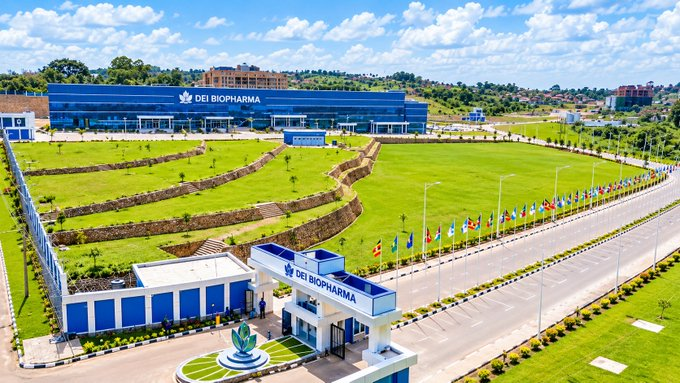
The Presidential Affairs Committee recommended the additional financing to help complete and operationalise Dei BioPharma’s 150-acre pharmaceutical manufacturing complex in Matugga, Wakiso District.
The facility is intended to manufacture medicines, vaccines, injectables, oncology products, penicillin and medical devices.
According to the committee’s report, the company produced and distributed six generic medicines during the 2024/2025 financial year, while several specialised production lines were still undergoing installation, validation or commissioning.
The committee argued that additional investment was needed to increase production, reduce dependence on imported medicines, create jobs and support exports.
It also recommended reliable electricity supply of up to 100 megawatts and adequate water infrastructure, citing the facility’s reported requirement of between seven million and 10 million litres of water daily at full operational capacity.
However, legislators questioned whether further financing should be approved before the Government establishes the value of the company, accounts for previous disbursements and verifies the terms of its ownership.
MPs question Government support to private companies
The debate also raised broader concerns about public financing for private enterprises.
Martin Kasule Mugabi, MP for Buzaaya County, questioned whether government contributions were reflected fairly in the reported shareholding arrangements.
Patrick Oshabe Nsamba, chairperson of the Public Accounts Committee for Central Government, questioned why the Government continued to support selected companies while other businesses also faced financial difficulties.
“Numerous companies also require bailout from government. Why does government continue to bail out these same companies which are problematic, but there are other genuine businesses which are saying we are also struggling?” he asked.
Oshabe proposed an open innovation fund as an alternative to repeatedly directing public resources towards selected enterprises.
The debate also touched on Inspire Africa Coffee, another company covered in the Presidential Affairs Committee’s report. Ssenyonyi questioned why the committee recommended that the Government present its contractual and financing framework to Parliament while also proposing an additional US$250 million investment.
The two proposals would amount to US$684 million, approximately Shs2.74 trillion, based on the rounded exchange-rate assumptions cited in the proposals. The combined figure represents proposed additional financing, not money already approved or disbursed.
The legislators’ concerns centre on whether public investments are supported by clear ownership records, independently assessed valuations, transparent contractual arrangements and verifiable implementation targets.
The Government’s stated objective of building domestic pharmaceutical manufacturing capacity remains part of the debate, but MPs are seeking evidence that the proposed additional funding is justified and that the taxpayer’s existing investment is adequately protected.
The October 7 debate did not, in the information presented, establish that the additional funding had been approved.

