


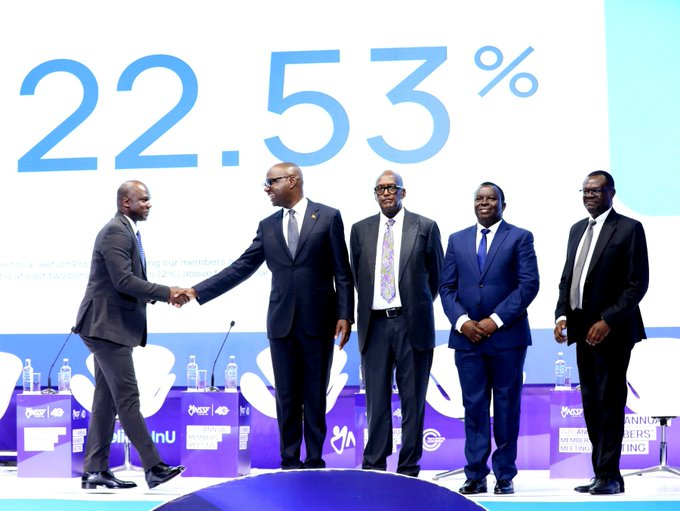
Finance Minister Henry Musasizi has, at the 14th NSSF Annual Members’ meeting, announced a record 22.53% interest rate for savers for the financial year 2025/26, translating into Sh5.44 trillion to be shared among members.
The payout is Sh2.64 trillion higher than the Sh2.79 trillion shared with savers last year and represents the highest interest rate in the history of NSSF.
Musasizi said the rate is above the 10-year average inflation of 4.1% and the 3.7% inflation recorded at the end of June 2026.
The Minister commended NSSF for its record performance and its position as the largest pension fund in East Africa, noting its growing contribution to long-term savings and Uganda’s socio-economic transformation.
He said the Government’s Tenfold Growth Strategy, which targets expanding Uganda’s economy to US$500 billion by 2040, will require increased mobilisation of domestic savings and investment.
“Uganda’s savings rate currently stands at 24% of GDP, but needs to rise to 40% by 2040 to match the level of investment required to support the country’s growth ambitions.”
Musasizi commended NSSF for investing in strategic infrastructure and other projects, while stressing that members’ savings must remain protected to generate competitive, risk-adjusted returns through commercially viable, professionally appraised and prudently governed investments.
He also pledged Government support to ensure the Fund operates in a competitive environment, including faster decisions on viable and time-sensitive investment opportunities.
Musasizi encouraged farmers, market vendors, students, boda boda riders and other informal-sector workers to take advantage of NSSF savings products and build long-term savings.
NSSF Managing Director Patrick Ayota noted that under its Vision 2035 strategy, NSSF aims to increase coverage to 15 million savers, equivalent to 50% of working Ugandans, while growing the Fund to Sh88 trillion and achieving 95% stakeholder engagement.
During the year, NSSF attracted 311,000 new members, taking coverage to 24.1% by June 2026.
Member contributions increased by 13% to Shs 2.4 trillion, up from Shs 2.13 trillion, while 55,000 dormant members were reactivated. The Fund paid Shs 1.5 trillion in benefits to 50,499 members.
Ayota said NSSF deployed Shs 4.54 trillion in investments during the year, with Sh4.32 trillion invested in Uganda. About 76% of the domestic investments were in bonds, alongside investments in equities and real estate.
The Fund also held Shs 10.2 trillion in regional investments across Kenya, Tanzania and Rwanda as part of its diversification strategy.
Ayota also highlighted the Fund’s wider economic contribution, including Shs 301 billion in taxes.
He said NSSF’s strategy is centred on expanding access to social security, creating capacity to save and investing members’ money in ways that generate long-term value while contributing to national economic development.
Gender Minister Gen. Henry Tumukunde challenged NSSF to move beyond safeguarding workers’ savings and position the Fund as a stronger catalyst for Uganda’s economic transformation.
“NSSF must increasingly see itself not simply as a custodian of savings but a catalyst for economic transformation.”
He said the Fund manages workers’ private savings and must ensure the resources are protected from erosion of value, prudently invested and deployed in initiatives that generate measurable value.
“This is a financial institution. It must run on the rules and competitiveness of a proper financial institution,” he said.

