
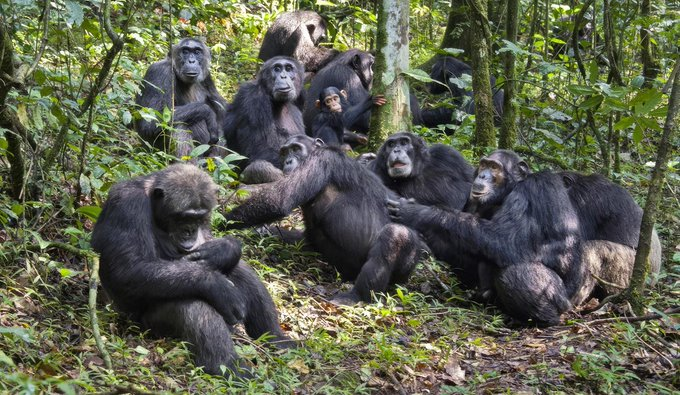

KIBALE NATIONAL PARK — The Uganda Wildlife Authority has dismissed reports of an ongoing “chimpanzee war” in Kibale National Park, clarifying that recent findings relate to long-term scientific observations rather than an active conflict.
UWA spokesperson Bashir Hangi said the reports stem from research on the Ngogo chimpanzee community, one of the most extensively studied primate groups in the world.
“There is no ongoing ‘chimpanzee war’ in Kibale National Park,” Hangi said. “What has been reported comes from the Ngogo chimpanzee community, a long-term research group that has been studied for over 30 years.”
Long-term research, not active conflict
According to Hangi, scientists documented a rare and gradual social split within the Ngogo community, a process that unfolded over nearly a decade.
“Researchers observed a gradual social division within the group, with some isolated past conflicts, but not a current active battle,” he explained.
Kibale National Park is globally recognized for primate research, particularly studies on chimpanzee behavior, social structures, and ecology.
Causes still unclear
Hangi emphasized that the drivers behind the observed split remain uncertain, despite several theories proposed by researchers.
“The drivers are not yet fully understood,” he said. “Scientists have suggested possible explanations, including pressures from large group size, shifting alliances, and the loss of key individuals, but no definitive cause has been established.”
Call for responsible reporting
The wildlife authority has urged media outlets and the public to avoid sensationalizing scientific findings, warning that misleading narratives could distort public understanding of wildlife behavior.
“This is high-level scientific research from one of the world’s leading primate study sites offering insight, not alarm,” Hangi said. “Let’s avoid sensational headlines and focus on facts.”
Global research significance
The Ngogo chimpanzee community in Kibale National Park has been the subject of continuous study for decades, contributing significantly to global knowledge on primate social systems.
Experts say such research is vital for conservation planning and understanding how environmental and social factors influence wildlife populations.
Authorities maintain that Kibale remains safe for tourism and research activities, with no unusual threats posed by chimpanzee behavior.