



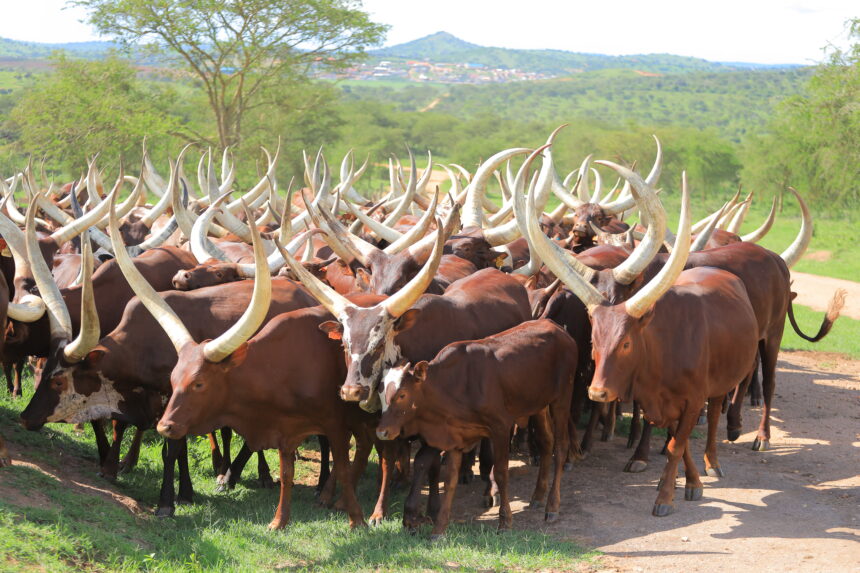
KIRUHURA, Uganda — Uganda’s indigenous Ankole Longhorn cattle are being selectively bred for higher milk production at the National Animal Genetic Resources Centre and Data Bank (NAGRC&DB) Nshaara Conservation Ranch in Kiruhura District, without introducing exotic dairy genetics.
The programme uses genetic selection, pedigree management, performance recording and improved nutrition to identify and multiply naturally occurring milk-producing traits within the pure Ankole population.
NAGRC&DB began the programme about three years ago by screening cattle at Nshaara and introducing selected superior Ankole genetics from recognised sources, including the Kisozi Ankole Longhorn conservation and improvement herd.
The objective, according to the centre, is to improve milk production while retaining the breed’s adaptability, resilience and genetic identity.
The breeding programme prioritises milk yield, followed by lactation length, udder conformation and calving interval. Replacement heifers are assessed using information on their mothers’ milk production, growth and fertility, alongside physical characteristics such as body structure, udder development and temperament.
As superior female lines have emerged, NAGRC&DB has increasingly focused on selecting breeding bulls from high-performing maternal families.
Candidate bulls are assessed partly on the milk-production performance of their dams, as well as growth rate, body size, maturity, reproductive soundness, testicular development, libido, temperament and other functional traits.
Dr Innocent Tuwangye, Manager of Nshaara Conservation Ranch, said the programme seeks to improve the breed from within its existing genetic population.
“We are not trying to turn the Ankole into an exotic dairy cow. We are identifying superior dairy traits that already exist within the pure Ankole population and systematically selecting and multiplying those genetics.”
“The objective is to develop an Ankole animal that produces more milk while retaining the adaptability, resilience and genetic identity for which the breed is known,” he said.
Milk production rises
NAGRC&DB says production records show a steady increase in average milk productivity as selection and herd management have continued.
In 2023, average recorded productivity stood at 5.2 litres per active cow per day, with annual production of about 56,040 litres. The active milking population increased from 24 cows in January to 35 by December.
In 2024, average productivity rose to 7.0 litres per cow per day, while annual recorded production reached about 106,358 litres. The milking herd increased from 36 cows at the beginning of the year to 47 by December.
By December 2025, average productivity had risen to 8.6 litres per cow per day, with annual recorded production of approximately 168,285 litres. The milking population grew from 47 cows in January to 60 by December.
The figures represent an increase of about 65.4% in average productivity between 2023 and 2025, alongside growth in the selected milking population.
At individual level, NAGRC&DB says some selected cows are recording substantially higher yields than traditionally observed among Ankole cattle.
While an Ankole cow under traditional production conditions may produce an average of about two litres during morning milking, selected animals in the programme are recording about five to 10 litres in a morning session, with some exceptional cows producing up to 12 litres between their second and seventh lactations.
One cow has recorded a peak morning yield of 14 litres.
Feeding and genetics
The programme has also highlighted the importance of nutrition in translating genetic potential into actual milk production.
NAGRC&DB has supplemented conventional grazing with hay and silage produced at Nshaara. The highest individual yields have been recorded under the improved feeding system.
Dr Peter Beine, Executive Director of NAGRC&DB, said genetic selection alone cannot sustain increased production without appropriate feeding and management.
“Our records are increasingly showing us that breeding and feeding must move together. Selection identifies the animal with superior genetic potential, but nutrition determines how effectively that potential is expressed.”
He said the production data is being used both to select breeding animals and to improve feeding and management practices for the emerging Ankole dairy population.
Production, reproductive and animal-health records are maintained in physical farm records and through NAGRC&DB’s Integrated Livestock Management Information System (ILMIS).
The system allows the breeding team to build individual animal performance histories and link production outcomes to specific animals and maternal lines.
From exceptional cows to a breeding population
The programme is now moving beyond identifying individual high-performing cows towards establishing superior performance across families and successive generations.
NAGRC&DB says this will require continued pedigree recording, identification of elite cows, selection of replacement heifers from proven maternal lines and the use of bulls from superior maternal families.
The centre says the objective is not simply to produce exceptional individual animals, but to make higher milk production increasingly predictable and heritable within the Ankole population.
“Our real measure of success will not simply be one exceptional cow,” Beine said.
“The breeding objective is to establish a population in which superior milk production can be consistently reproduced from one generation to another. That is why pedigree integrity, individual animal identification, performance recording and selection of proven maternal and sire lines are central to what we are doing at Nshaara.”
The programme positions Nshaara as a centre for demonstrating how Uganda’s indigenous cattle genetics can be improved for commercial productivity while retaining the characteristics that have allowed the Ankole Longhorn to adapt to local conditions.
What began with the identification of naturally superior milk-producing Ankole cows is now developing into a structured breeding programme aimed at establishing a productive, genetically stable and resilient pure Ankole dairy population.

