


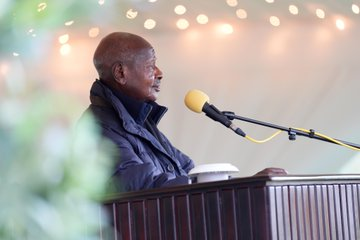
Kampala, Uganda — Uganda has taken a major step toward protecting its creative industry after President Museveni signed the Copyright and Neighbouring Rights (Amendment) Act, 2026 into law on April 29, ending decades of largely unpaid music airplay on radio and television.
The new legislation requires broadcasters, bars, hotels, and other public venues to pay royalties for music they use commercially. These payments will be collected and distributed through bodies such as the Uganda Performing Rights Society, marking a structural shift in how Ugandan artists earn from their work.
The law’s implementation is already underway, with the rollout of a locally developed music tracking system known as “Nyange.” According to statements shared online by Eddy Kenzo, the device is being installed in venues and media houses to monitor music usage and ensure accurate royalty distribution. The system uses digital tracking tools to identify songs played in public spaces, linking them to registered artists for compensation.
Media personality Douglas Lwanga also reported that installation of the devices is ongoing across the country, describing the move as a milestone in modernising Uganda’s copyright enforcement.
Under the law, businesses that fail to comply risk fines of up to UGX 50 million, signalling a tougher stance on intellectual property violations. Supporters say the reforms could significantly boost incomes for musicians who have long complained about exploitation and lack of compensation.
Kenzo hailed the development as a “milestone for music’s protection,” reflecting years of advocacy by industry stakeholders.
However, not all reactions have been uniform. Popular artist Azawi drew attention after offering to allow broadcasters to play her music for free, a gesture that prompted some radio executives to seek formal permissions to avoid breaching the new law.
Meanwhile, some commentators have raised concerns about enforcement. Critics question whether venue owners or DJs could bypass the tracking system, and whether the technology can accurately recognise Uganda’s diverse music catalogue, including remixes and local variations. Others have called for independent auditing mechanisms to ensure transparency in royalty distribution, as well as clarity on data privacy.
The introduction of the Nyange system, combined with the new legal framework, represents one of Uganda’s most ambitious efforts to formalise its music economy. If effectively enforced, the reforms could reshape the relationship between artists, broadcasters, and businesses—ensuring that creators are compensated for the widespread use of their work.
Officials say the rollout will continue in phases, with artists encouraged to register their music in centralised databases to benefit fully from the new system.

