



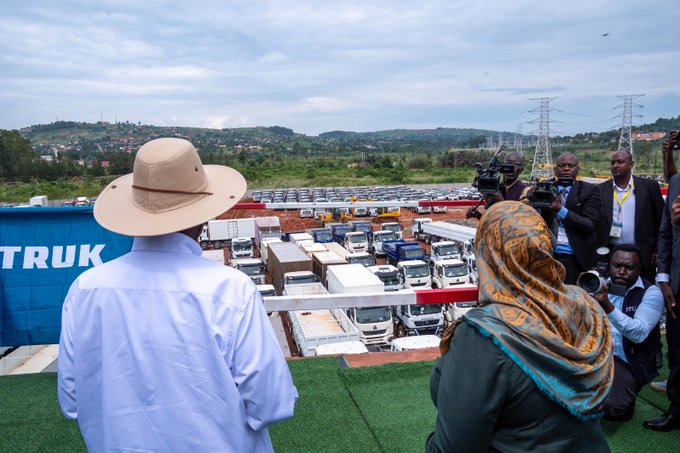
MPIGI — President Yoweri Kaguta Museveni and his Tanzanian counterpart, President Samia Suluhu Hassan, have called on East African countries to deepen economic integration and coordinate industrial investments, saying regional cooperation is essential for expanding manufacturing, trade and employment.
The two leaders made the remarks on Thursday while commissioning the Double Q Automotive Assembly Plant in Nakirebe, Mpigi District, a Shs110 billion investment that assembles heavy-duty trucks in partnership with Chinese manufacturer Sinotruk.
President Museveni said the investment would strengthen Uganda’s automotive industry by linking vehicle assembly to local suppliers and creating opportunities for domestic value addition.
“I thank Double Q and their partners, Sinotruk, for investing in Uganda to assemble trucks here and for linking up with our local industry. They are already doing value addition, and I was pleased to hear that when our steel industry grows, we shall use local steel to produce local parts. That is very good,” President Museveni said.
He used the occasion to call for closer economic cooperation between Uganda and Tanzania, arguing that the two countries should combine their natural resources and industrial capabilities rather than pursue development separately.
“Our prosperity depends on production, trade and cooperation. If Uganda has iron ore and Tanzania has gas, why should we work separately? By combining our resources, integrating our economies and opening up bigger markets, we produce more and prosper together,” he said.
President Museveni said this was the thinking behind the East African Community, adding that deeper integration would give businesses access to larger markets and create more opportunities for citizens.
He also thanked China for its longstanding cooperation with Uganda and Africa, noting that the continent’s population of about 1.5 billion is projected to reach 2.5 billion in the next 30 years.
“This is the business centre of the future,” he said.
President Suluhu described the plant as an important milestone in Uganda’s industrialisation journey and congratulated the government for supporting domestic manufacturing initiatives, including Double Q Automotive and Kiira Motors.
She said industrialisation was no longer merely an economic option but a necessity for African countries seeking to create employment, add value to their resources, transfer technology, expand exports and reduce dependence on imported manufactured goods.
The Tanzanian leader urged East African Community member states to accelerate their transition from predominantly agricultural economies towards industrial production, while modernising agriculture to supply raw materials to manufacturing industries.
“Let us turn from being consumers of imported goods to regional production and marketing hubs. We should aspire to manufacture, assemble, and produce,” she said.
However, she cautioned against unnecessary competition among countries establishing similar industries, calling for complementary industrial policies that would strengthen regional production chains.
Citing Sinotruk’s operations in both Uganda and Tanzania, President Suluhu said the investments should be treated as opportunities for cooperation rather than competing ventures.
“East Africa must compete with the world, not within itself,” she said.
She also welcomed proposals to harmonise regulations governing vehicle assembly and manufacturing across the region, arguing that common standards would create a larger market for locally manufactured products.
President Suluhu revealed that Tanzania was exploring partnerships to establish a railway locomotive manufacturing plant as part of efforts to expand its domestic industrial capacity.
She further pointed to the growing demand for transport and logistics services in the region, citing the Port of Dar es Salaam, which she said handled approximately 33 million tonnes of cargo in 2026.
The growing movement of goods, she said, presented an opportunity for East African countries to expand their transport and vehicle manufacturing industries.
The plant and its capacity
The Double Q facility, located in Nakirebe, has an annual assembly capacity of 4,000 heavy-duty trucks and directly employs more than 1,200 people, according to government information.
The company began assembling Sinotruk vehicles in Uganda in 2020 and has since assembled more than 5,000 trucks. It also exports to regional markets, including South Sudan, Rwanda, Tanzania and the Democratic Republic of Congo.
The company has indicated plans to expand beyond truck assembly into passenger vehicles and electric trucks, while increasing the use of locally sourced materials and components.
The government is also working with the company to develop a pathway for increasing local content in the vehicles, including greater participation by Ugandan suppliers and manufacturers.
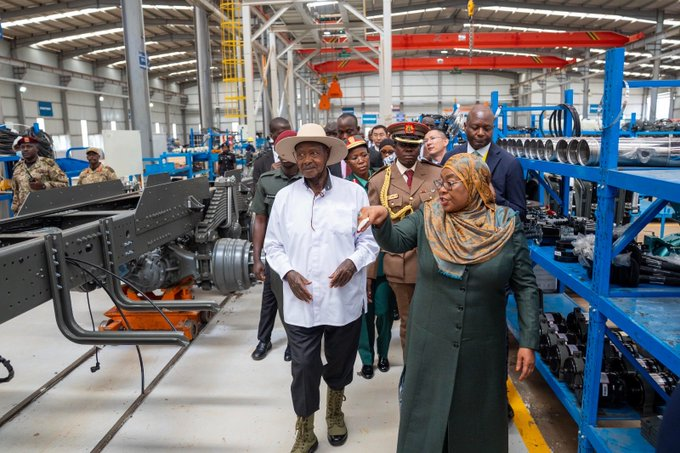
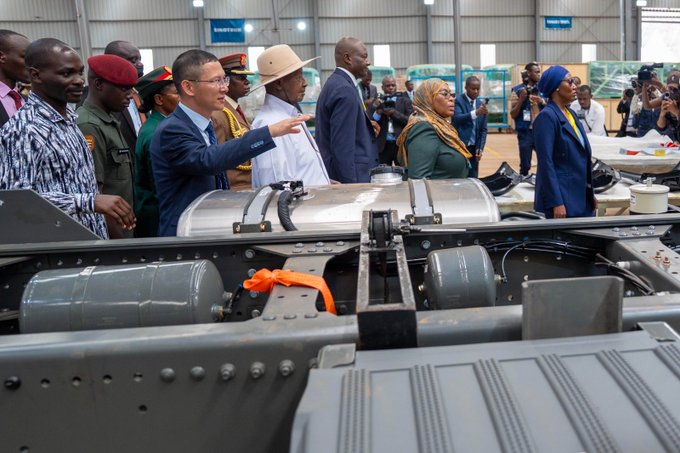
Earlier, the two presidents toured the facility, inspected its production lines and interacted with management, engineers and employees.
The commissioning took place during President Suluhu’s two-day state visit to Uganda, which has included discussions on trade, investment, infrastructure, energy and regional economic cooperation.

