



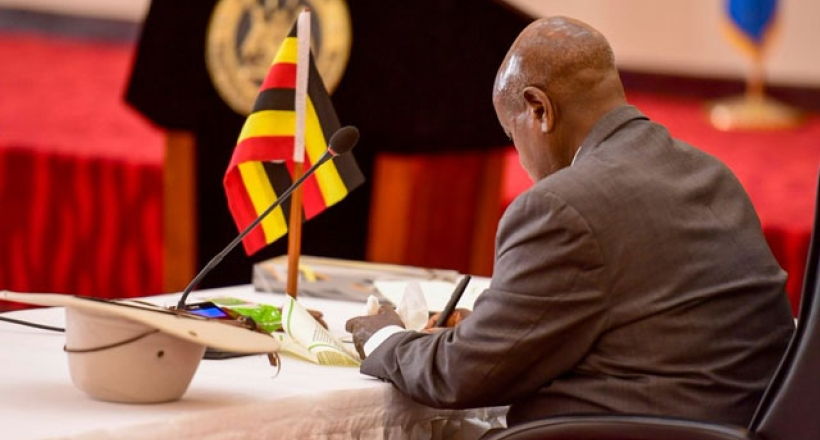
President Yoweri Kaguta Museveni has signed the Protection of Sovereignty Act, 2026 into law, introducing sweeping new measures aimed at regulating foreign-linked activities, funding and influence in Uganda.
The announcement was made through a statement issued by the Presidential Press Unit, confirming that the President had formally assented to the Bill after its passage by Parliament.
According to government, the new law is intended to strengthen Uganda’s sovereignty by establishing legal mechanisms for the registration and regulation of foreign agents, oversight of foreign assistance and coordination of activities deemed relevant to national peace and security.
“The Act is intended to provide for the protection of the sovereignty of the people of Uganda,” the Presidential Press Unit said in the statement.
Under the law, the department responsible for peace and security under the Ministry of Internal Affairs will oversee implementation and enforcement.
Government officials say the legislation is designed to reduce undue foreign interference in Uganda’s domestic affairs while strengthening accountability and institutional coordination.
Authorities further argue that the Act will ensure that all foreign-linked operations within Uganda function transparently and within the country’s legal framework.
The law comes at a time when several African governments are increasingly debating issues surrounding sovereignty, foreign funding, civil society influence and national control over governance processes.
Supporters of the legislation say Uganda has for years lacked a comprehensive legal framework to regulate organizations and individuals acting on behalf of foreign interests, particularly in politically sensitive sectors such as governance, advocacy and national security.
However, the new law has triggered concern among civil society organizations, opposition leaders and governance activists who fear it could be used to tighten restrictions on NGOs and foreign-funded institutions.
Critics argue that broad enforcement powers under the legislation could shrink civic space and affect organizations involved in democracy, accountability and human rights advocacy.
Some observers have also warned that the law may attract criticism from international partners and donor agencies concerned about operational freedoms and Uganda’s engagement with foreign-supported organizations.
Despite the criticism, government maintains that the Act is not intended to block international cooperation or development partnerships but rather to ensure that foreign-linked activities operate in accordance with Uganda’s national interests and security priorities.
Political analysts say attention will now shift to the implementation phase, including regulations and operational guidelines expected from the Ministry of Internal Affairs.
The Protection of Sovereignty Act is already being viewed as one of the most politically consequential laws enacted in Uganda in recent years, with its impact expected to shape future debates on governance, national security, civil society operations and Uganda’s international relations.

