



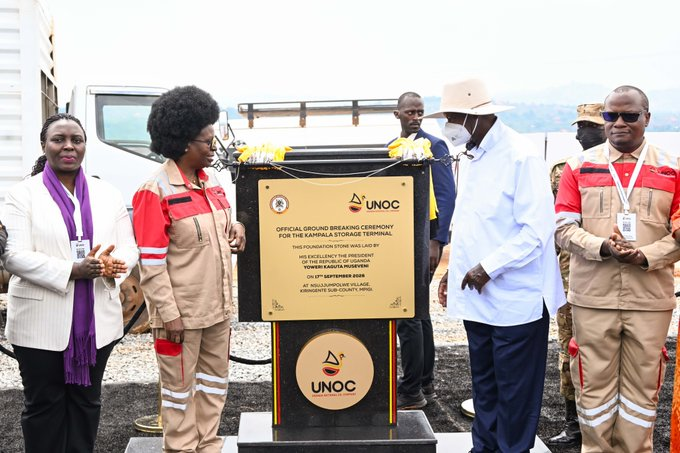
President Yoweri Kaguta Museveni on Thursday broke ground for the construction of the Kampala Storage Terminal (KST), a US$310 million (about Sh1.15 trillion) petroleum facility in Namwabula, Mpigi District.
The terminal, being developed by the Uganda National Oil Company (UNOC), will have capacity to store 320 million litres of refined petroleum products, including petrol, diesel, aviation fuel and kerosene.
Uganda consumes an estimated 240 million litres of petroleum products each month, meaning the planned terminal’s capacity is equivalent to slightly more than one month’s national consumption. It will complement the existing 30-million-litre Jinja Storage Terminal and private-sector depots.
The facility is being built on approximately 300 acres at Namwabula, about 26 kilometres west of Kampala. It is intended to provide space for government strategic reserves, storage and handling services for oil marketing companies, and distribution of petroleum products to Kampala, the Central Region and other parts of Uganda.
UNOC said the terminal is also intended to strengthen Uganda’s ability to withstand disruptions along petroleum import routes and external supply shocks.
The project forms part of a wider petroleum infrastructure network being developed as Uganda moves towards domestic oil production and refining. The terminal is planned to connect to the proposed refinery in Hoima through a 211-kilometre multi-products pipeline, allowing it eventually to receive locally refined petroleum products for storage and distribution.
During the groundbreaking ceremony, Museveni said Uganda had previously been buying petroleum products through middlemen in Kenya.
He said government intervention had reduced the prices at which Uganda buys petroleum products, citing diesel prices falling from US$118 to US$83 per metric tonne, petrol from US$97.50 to US$61.50, and aviation fuel from US$114.25 to US$79.25.
Museveni also said Uganda should strengthen alternative and safer transportation systems for petroleum products, including the use of pipelines and water transport routes on Lake Victoria.
The President said Uganda’s growing petroleum infrastructure should be accompanied by stronger strategic reserves as the country prepares for domestic oil production.
The government has also been working to diversify petroleum supply routes. The Ministry of Energy and Mineral Development says Uganda has partnered with Lake Victoria logistics operator Mahathi Infra Terminal, whose facility has a 70-million-litre capacity, to improve the efficiency of petroleum transportation and reduce supply risks.
The Kampala Storage Terminal is expected to become a key link between Uganda’s future refinery and the domestic petroleum distribution network.
UNOC Board Chairman Mathias Katamba said the facility would strengthen Uganda’s capacity to maintain adequate petroleum reserves and respond to disruptions affecting import corridors and global supplies.
The project is also part of the government’s wider plans to expand petroleum storage as Uganda develops its oil industry, with the terminal expected to serve both imported products and, once the refinery and pipeline infrastructure are operational, fuel produced locally.

