



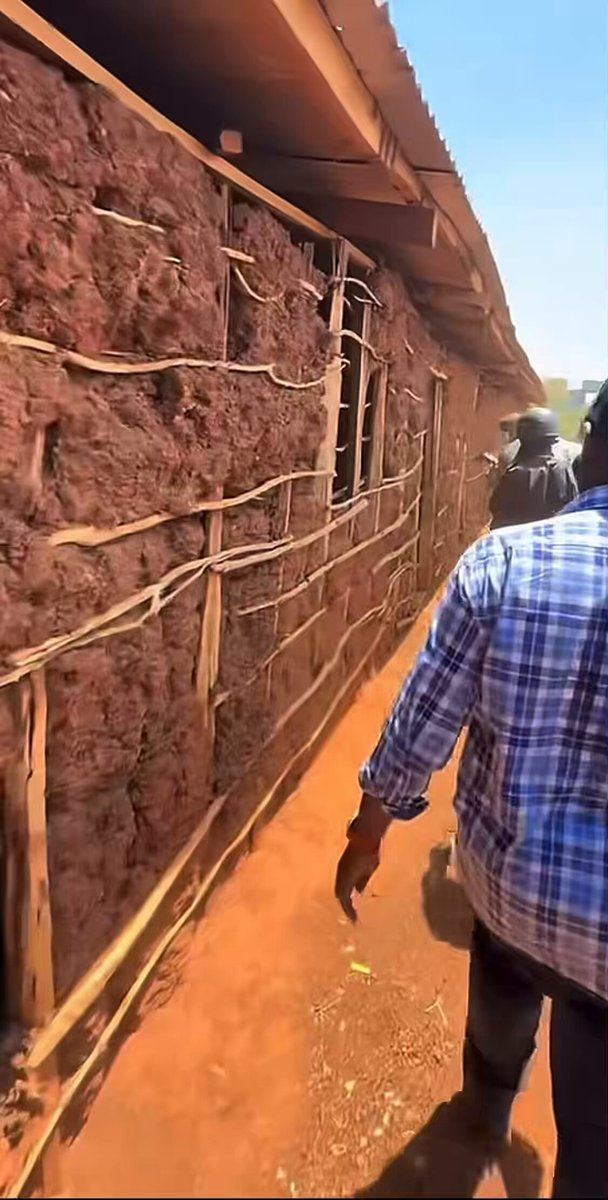
KWEEN, Uganda — Local Government Minister Balaam Barugahara Ateenyi has raised concerns over the state of education infrastructure in Kween District after visiting a primary school where nursery and Primary Seven pupils are reportedly studying in mud structures reinforced with poles and wires.
The minister encountered the school during his ongoing nationwide “Expose the Corrupt” campaign, which has taken him to districts across Uganda to inspect government facilities, question local officials and hear complaints from residents about poor service delivery.
The condition of the school has drawn renewed attention to the gap between government spending on education and the physical environment in which some Ugandan children are expected to learn.
According to accounts of the visit circulated on social media, the classrooms are constructed largely from mud, with poles and wires providing additional support. The pupils reportedly walk long distances to attend school.
The minister pledged to bring the condition of the school directly to the attention of President Yoweri Museveni and seek urgent intervention.
The visit came as Barugahara toured the Sebei sub-region, where Kween was one of the districts targeted by the anti-corruption inspection campaign. The Ministry of Local Government had announced that the Kween visit would focus on complaints about poorly implemented government projects and alleged misuse of public resources.
The scale of the infrastructure problem is reflected in district education figures.
Kween District’s education department reports 31,932 pupils enrolled in Universal Primary Education schools, served by 507 teachers and 250 permanent classrooms in government primary schools. The district records a pupil-to-classroom ratio of 88:1 and a pupil-to-desk ratio of 4:1.
The figures mean that, on average, 88 pupils are competing for a classroom space designed for a substantially smaller number, while four pupils share a desk.
The district also reports a pupil-to-teacher ratio of 53:1 and a pupil-to-latrine ratio of 115:1. Its primary completion rate stands at 70 percent.
National data presents a somewhat different picture because it includes private as well as government institutions. Uganda Bureau of Statistics’ 2025 Baseline Education Census recorded 22,548 primary pupils in Kween across 126 primary schools, of which 40 were public and 86 private. The census also recorded 781 primary teachers.
The disparity between the official figures does not erase the underlying problem: some communities continue to rely on inadequate infrastructure despite decades of government investment in universal education.
And this is where the Kween story becomes larger than one school.
What does it mean to tell a child that education is the road out of poverty while asking that child to spend the day inside a structure that looks barely capable of surviving the weather?
Anti-corruption campaign reaches schools
Barugahara’s inspection tour is part of a wider campaign launched in July under the government’s drive to expose corruption and improve service delivery in local governments.
The Ministry of Local Government says the campaign involves surprise inspections, public accountability meetings and investigations into allegations of corruption, absenteeism, misuse of public funds and poorly implemented projects.
The campaign has already produced disciplinary action.
According to Daily Monitor, 110 local government staff were facing disciplinary cases by August 18, with more than 19 cases referred to the Anti-Corruption Court. The allegations have included ghost workers and pupils, misuse of public funds, procurement irregularities, absenteeism and poorly implemented government projects.
Barugahara has defended the inspections as more than public spectacle.
“The purpose of our inspections is not simply to expose wrongdoing. It is to identify leakages, stop them, protect public resources and ensure that citizens receive the services for which the government provides money.”
The minister has previously argued that public resources must produce visible services for citizens.
During the campaign’s national launch in Bulambuli in July, he said: “We have not come to Bulambuli for flowers; we have come to work.”
The campaign has nevertheless generated political debate. Shadow Auditor General Elias Luyimbazi Nalukoola questioned whether ministerial field tours could produce lasting accountability, arguing that Uganda already has institutions mandated to investigate corruption.
Kween under scrutiny
The minister’s arrival in Kween followed warnings from district leaders that civil servants should remain at their stations and account for their performance.
Kween District LCV Chairperson Paul Majinjach Kapchemaiko warned officials against fleeing to neighbouring Kenya to evade the inspection, saying the minister’s visit should instead be treated as an opportunity for officials to explain failures in service delivery.
The inspection has since extended beyond schools. The Ministry of Local Government reported that Barugahara also visited Tuikat Health Centre II and other facilities in Kween, where he assessed service delivery problems and promised to lobby for improvements.
The minister also visited the Sebei Presidential Industrial Hub in Kween, where he urged trainees to use vocational skills to create their own employment.
Yet the image of pupils studying in mud classrooms presents a harder question than the rhetoric of development.
Uganda has expanded access to primary education enormously since the introduction of Universal Primary Education. But access is only the first question. What kind of education are children actually receiving when classrooms are overcrowded, desks are shared by four pupils and some learning spaces remain vulnerable structures?
A school can exist on paper. A pupil can exist in the enrolment register. Money can be released.
But where is the classroom?
And when the answer is a mud wall held together by poles and wire, who exactly has received the education investment — the child, or the system that claims to serve the child?

