



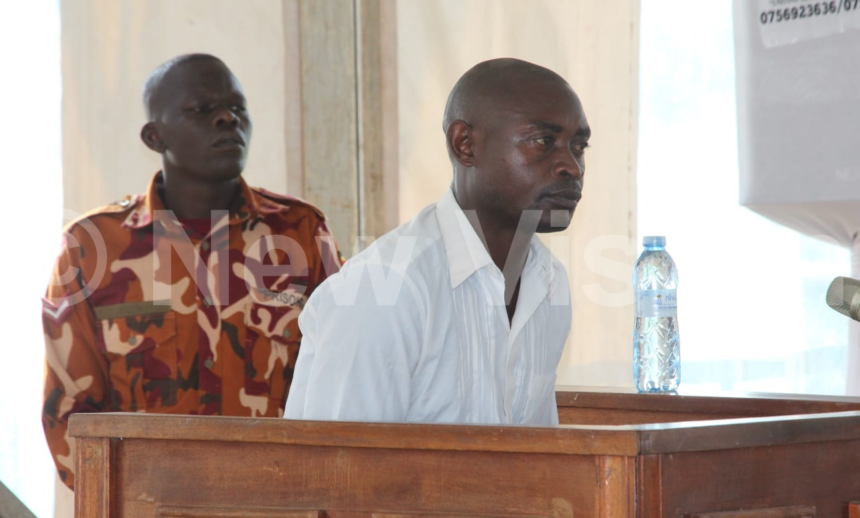
The High Court in Masaka has admitted a confession statement made by murder suspect Kulayisi Kamugisha, alias Fred Mujulizi, despite his claims that police detectives tortured him into admitting responsibility for the crime.
Justice Vincent Wagona, presiding over mobile court proceedings at Ssaza Grounds, rejected a defence objection challenging the admissibility of the statement, paving the way for the prosecution to present it as evidence.
Kamugisha’s lawyer, Innocent Kaliba, had opposed the introduction of the confession, arguing that it was obtained through coercion and was therefore involuntary.
The statement was recorded on October 11, 2026.
During the proceedings, Kamugisha told court that detectives beat him to force him to confess to the murder, raising questions about the circumstances under which police obtained the statement.
However, Justice Wagona dismissed the defence objection and admitted the statement into evidence.
The judge subsequently directed Kamugisha to prepare his defence and indicate the witnesses he intends to call.
Kamugisha is accused of murdering an unidentified woman in Masaka District in September 2026.
According to the prosecution, he allegedly lured the victim from Lukaya before killing her on or around September 28, 2026, at Mugamba Village in Buwunga Sub-county.
Prosecutors further allege that after the killing, Kamugisha dumped the victim’s head at Kako Village and abandoned her headless body at a separate location.
The circumstances surrounding the alleged killing form the basis of the murder charge against him.
Kamugisha has denied the accusation.
The admission of the confession means the prosecution can rely on the statement as part of its evidence against the accused, although its weight will ultimately be considered alongside the other evidence presented during the trial.
The proceedings are continuing under the Judiciary’s mobile court arrangement in Masaka, which brings court services closer to communities outside the traditional courtroom setting.

