



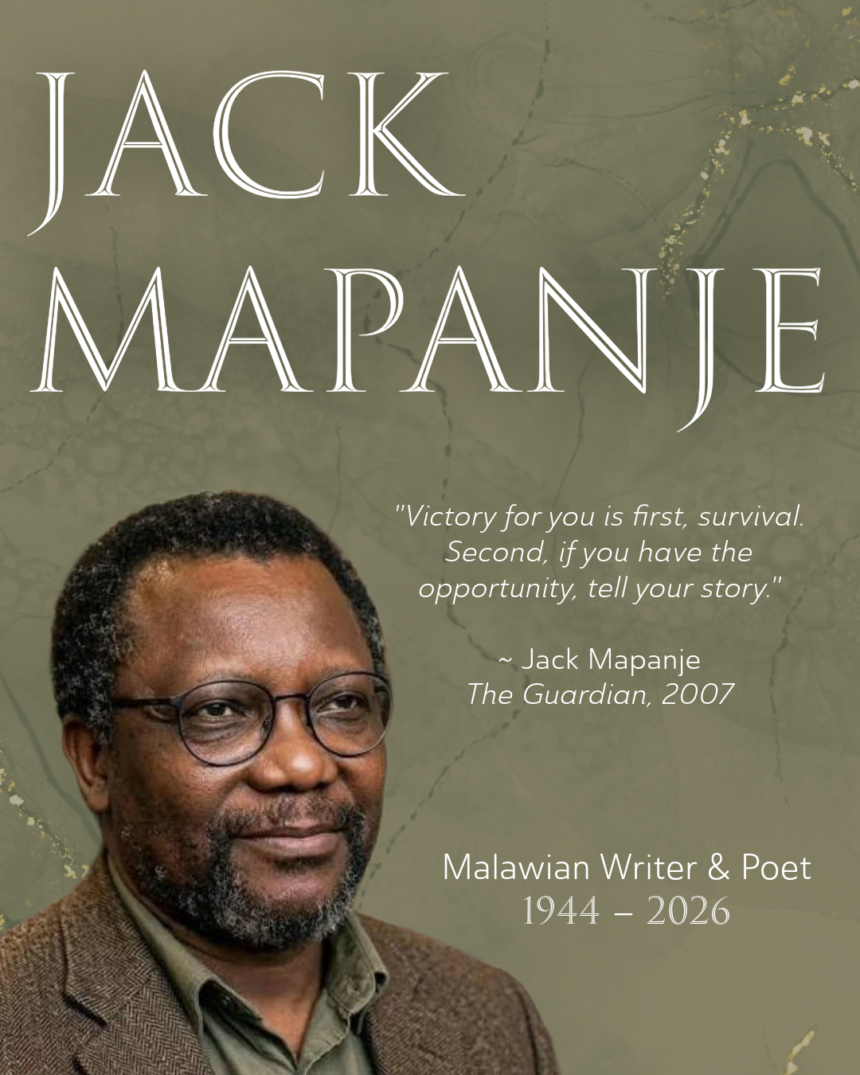
LONDON — Renowned Malawian poet, academic and former political prisoner Jack Mapanje has died aged 82, leaving behind a body of work that challenged political repression and documented the struggle for intellectual freedom in Africa.
Mapanje died in Britain on November 4, 2026, following an illness, according to a tribute issued by the African Poetry Book Fund on Thursday.
Born on March 25, 1944, Mapanje became one of Malawi’s most recognised literary figures, using poetry to question political authority, expose corruption and explore the experiences of people living under repressive governments.
His literary career came under pressure after the publication of his first collection, Of Chameleons and Gods, in 1981. The book was banned by the Malawian government, and in September 1987 he was arrested and detained without charge at Mikuyu Prison.
He spent nearly four years in prison, remaining behind bars until May 1991. His detention, however, did not silence his writing.
While imprisoned, Mapanje received the Rotterdam Poetry International Award in 1988. He also wrote much of the material that would later appear in The Chattering Wagtails of Mikuyu Prison (1993) and Skipping without Ropes (1998).
His prison experience became a defining subject in his poetry, which examined the effects of state power on individual freedom, the struggle to preserve dignity and the determination to tell one’s story despite attempts at silencing.
“Victory for you is first, survival. Second, if you have the opportunity, tell your story,” Mapanje said in a 2007 interview with The Guardian.
After his release, Mapanje moved to Britain, where he continued his literary work and taught Creative Writing and Literatures of Incarceration at Newcastle University.
His later publications included The Last of the Sweet Bananas (2004), Beasts of Nalunga (2007) and Greetings from Grandpa (2016). In 2011, he published And Crocodiles Are Hungry at Night, a memoir recounting his arrest, imprisonment and efforts to understand the reasons behind his detention.
Across his writing, Mapanje returned to themes of political repression, exile, the search for home, African liberation and reconciliation. His work was also distinguished by humour, vivid imagery and a storytelling style influenced by the fictional tales of his childhood.
The African Poetry Book Fund described him as an enduring figure in Malawi’s struggle for intellectual freedom, noting that his years in Britain brought both professional opportunities and the experience of living away from home.
Mapanje authored and edited more than ten books, including five volumes of poetry. His work earned him recognition among African writers and readers interested in the relationship between literature and political power.
The African Poetry Book Fund has encouraged readers to revisit his work through his books, recorded readings and interviews, including a 2008 poetry reading at Brown University’s Under the Tongue: A Festival of Literature from Africa.
He is survived by his wife, Mercy Mapanje, their two daughters and son, Lunda Mapanje, as well as friends, colleagues and former students.

