



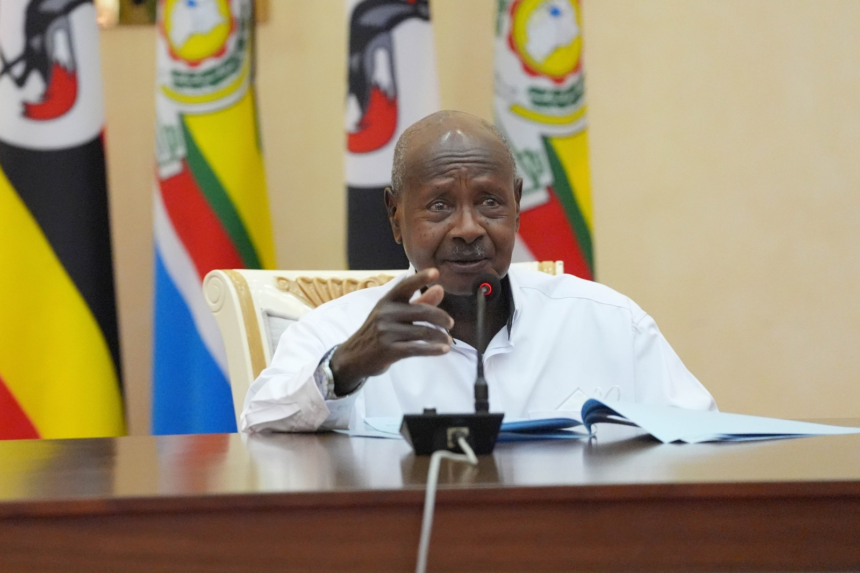
KAMPALA, Uganda — President Yoweri Kaguta Museveni has declared that no member of Uganda’s security forces will be shielded from accountability if they abuse their authority, while defending recent security operations as necessary to protect peace, uphold the rule of law and eliminate what he described as a culture of impunity.
Speaking during a televised national address on Saturday, the President sought to reassure Ugandans that the government remains committed to justice, saying accountability must apply equally to civilians and members of the military, police and intelligence agencies.
“I cannot allow impunity in our system even on the side of the security forces,” President Museveni said.
His remarks come amid heightened public concern over allegations of enforced disappearances, unlawful detentions and excessive use of force by some security personnel during recent operations.
The President acknowledged that religious leaders, through the Inter-Religious Council of Uganda, had raised concerns over justice and human rights, warning that Uganda’s hard-earned peace should not be undermined by abuses committed by state actors.
However, he maintained that the recent actions by security agencies were intended to strengthen, rather than weaken, the rule of law.
“The recent limited actions by Security forces against some individuals and institutions are, really, long overdue actions to fill those gaps,” he said.
Security operations aimed at protecting stability
President Museveni defended ongoing security operations against individuals accused of threatening national security, arguing that they were necessary to safeguard the achievements Uganda has made over the past four decades.
He said the peace that Ugandans often describe as “Wakili, twebakka kutulo”—meaning people can now sleep peacefully without fear—must be reinforced by eliminating corruption, criminality and impunity.
“‘Wakili twebakka kutulo’ created mainly by the UPDF, and ‘boona bagaggawale’ created by the NRM… must also be reinforced by no more corruption and now no more impunity by selfish people and agents of foreign interests,” he said.
The President argued that while Uganda has registered significant economic growth and political stability, failures by some political leaders, bureaucrats and judicial officers to enforce accountability have allowed corruption and crime to persist.
Indigenous justice versus colonial legal traditions
A significant portion of the address focused on what President Museveni described as the contrast between indigenous systems of justice and colonial legal traditions.
He said traditional African justice emphasised truth, accountability and reconciliation rather than legal technicalities.
“Our concept of justice was mainly based on the indigenous concept of justice. The indigenous communities insist on full accountability or restorative justice… In the end, what matters is: ‘What was the truth?'” he said.
To illustrate the point, the President recalled the execution of National Resistance Army fighters who killed civilians during the liberation struggle, arguing that such actions helped establish public confidence in the movement.
“It is that initial act of balanced justice that catapulted the prestige of the NRM in Buganda and Uganda. The Baganda said: ‘Banobalina amazima’—these are people of truth and justice.”
Criticism of the justice system
President Museveni also criticised aspects of Uganda’s judicial system, saying indiscriminate granting of bail and police bonds has enabled repeat offenders to evade accountability.
“Even with the colonial law, bail is, apparently, only given when the accused cannot interfere with the case. However, you have seen rampant cases of policemen giving bonds or magistrates giving bail to village thieves that are threatening rural agriculture,” he said.
He argued that weaknesses within the legal system have contributed to public frustration and, in some cases, mob justice.
Comments on Dr Kizza Besigye
The President also commented on opposition leader Kizza Besigye, who remains before the courts on criminal charges.
President Museveni questioned why Dr Besigye had allegedly declined to proceed with trial.
“Take the case of Besigye. He was arrested on the 17th of November, 2024. All this time, however, he has been refusing trial, misusing the legal system.”
He added:
“Why would this great democrat and human rights fighter spend so many calories on refusing to come to trial where he has got opportunity to prove his innocence?”
The President further argued that suspects accused of intimidating witnesses should not automatically qualify for bail.
“The arrested opposition law-breakers may not get bail because they threaten the security of the witnesses.”
Rejects claims of democratic backsliding
Responding to criticism that Uganda is reverting to the authoritarian practices of previous governments, President Museveni dismissed the claims, insisting today’s suspects are processed through the courts rather than being killed or disappearing without trial.
“Those who have been putting forward the slogan ‘Bizeemu’—meaning ‘the bad things of the past have come back’—are wrong.”
He maintained that the country’s security agencies are acting within the law while emphasising that officers who violate citizens’ rights will also be held accountable.
Referring to the death of a man known as “Zebra” following contact with security personnel in 2021, the President noted that the government had compensated the victim’s family as part of efforts to ensure accountability.
“I cannot allow impunity in our system even on the side of the security forces.”
Hawkers, wetlands and corruption
Beyond security, President Museveni defended the government’s crackdown on street hawking, describing the practice as harmful to public health and legitimate businesses.
“Hawking is an economy and health killer,” he said, urging local governments to establish organised trading spaces while ensuring all businesses are registered and tax compliant.
On environmental conservation, the President reaffirmed the government’s commitment to reclaiming wetlands and protecting forests.
“The operation to restore the wetlands and protect our natural forests will continue.”
He warned that continued wetland encroachment threatens Uganda’s rainfall patterns and future water security.
Call to elect accountable leaders
President Museveni concluded by urging Ugandans to participate in the upcoming Local Council I and Women Council elections, saying the polls provide an opportunity to elect leaders committed to fighting corruption.
“I am hearing of the corruption in the health centres, in the PDM, etc. The medicines for those problems are two. One, report the corruption… Secondly, use the LC-1 elections and the Women Council elections to elect leaders that will fight corruption.”
He added: “Corrupt people are easy to defeat—just report them.”