



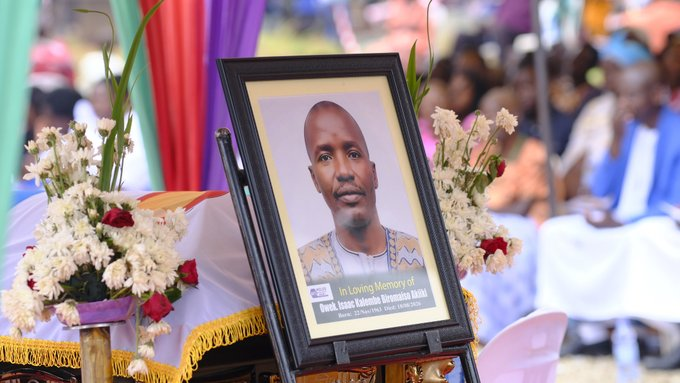
HOIMA — The Bunyoro-Kitara Kingdom on Friday laid to rest Owek. Isaac Kalembe Biromaiso Akiiki, the former Speaker (Omutalindwa) of the Bunyoro-Kitara Kingdom Parliament, at his ancestral home in Dwoli, Hoima District.
Kalembe, who died on August 18, 2026, aged about 70, was buried following a series of funeral services in Kampala and Hoima. The burial at Dwoli-West, Kiragura Parish, followed a memorial service at the Bunyoro-Kitara Kingdom headquarters in Hoima City and a church service at St Peter’s Cathedral, Duhaga, on Thursday. The burial programme had scheduled his interment for 11am on Friday.
The former Omutalindwa was remembered as a scholar, historian, author, journalist, cultural leader and peacemaker who devoted much of his life to documenting the history and cultural heritage of Bunyoro-Kitara.
Kalembe served as Speaker of the Rukurato, the kingdom’s parliament, from October 2018 to October 2023. He was also a former spokesperson of the kingdom and had earlier worked in the Public Relations department of the Uganda Communications Commission before retiring from its library department.
Bunyoro-Kitara Kingdom Prime Minister, Owek. Andrew Byakutaga Ateenyi, described Kalembe as a respected writer and historian whose work helped document Bunyoro’s traditions, clan histories, naming practices and cultural practices.
“He was a writer and historian of Bunyoro-Kitara,” Byakutaga said during the funeral programme.
Kalembe was particularly known for his research on Omukama Cwa II Kabaleega. His book, Omukama Cwa II Kabaleega: A Life and Legacy, 1853–1923, remains one of his best-known works on the Bunyoro king and his historical legacy.
His scholarship extended beyond Kabaleega’s political life to broader questions of Bunyoro’s history, culture and identity.
The Kingdom also credited him with contributing to the strengthening of cultural institutions and the documentation of traditions, including language, Empaako, traditional medicine, ceremonies and cultural practices.
Kalembe’s career also included journalism. He worked with Bunyoro Broadcasting Services, where he served as an editor and later station manager, before joining the Uganda Communications Commission. His former colleagues remembered him as a knowledgeable and supportive partner to journalists.
His death brought together kingdom leaders, family members, religious leaders, elders, former colleagues and members of the public who gathered to pay their final respects.
Tributes portrayed Kalembe as a humble and wise man who valued unity and reconciliation.
He was also remembered as a skilled negotiator and team player who rejected divisionism and placed the interests of Bunyoro and Uganda above personal differences.
The funeral also renewed calls for the preservation of his intellectual legacy, including his writings and historical research.
For a man who spent much of his life recording the past, his burial at his ancestral home in Dwoli marked the final entry into the history he had worked so hard to preserve.
Kalembe’s death leaves behind a body of work that future generations of Bunyoro historians, researchers and cultural leaders will have to carry forward.
His life had been devoted to a simple but consequential question: what happens to a people’s history when those who remember it are gone?
He spent his life writing against forgetting.
Now Bunyoro must decide what it will do with what he left behind.

