


More than six decades after his assassination, Patrice Lumumba—Congo’s first Prime Minister following independence—continues to cast a long cultural and political shadow across the Democratic Republic of Congo (DRC). His image, long associated with anti-colonial resistance and national pride, is now being kept alive in an unusual but powerful way inside football stadiums, through the ritual of one devoted supporter.
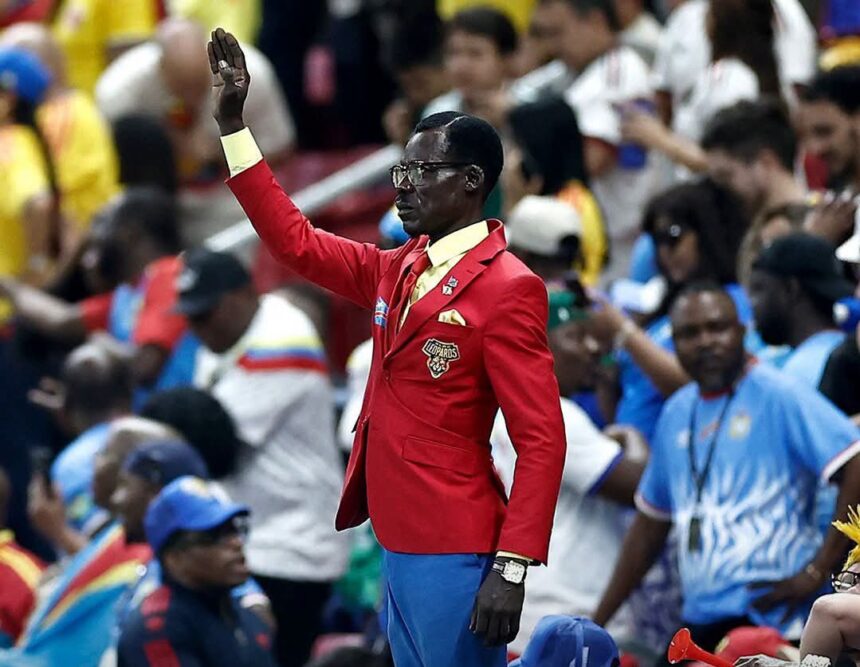
At the 2026 FIFA World Cup, Michel Kuka Mboladinga, widely known as “Lumumba Vea,” has drawn global attention for his striking matchday performance: standing completely motionless for the entire 90 minutes of a football match, arm raised in a fixed salute inspired by Lumumba’s iconic statue in Kinshasa.
According to international reports, Mboladinga’s act is not a performance for spectacle alone, but a symbolic tribute to Lumumba’s legacy of dignity, independence, and national identity. His posture, carefully maintained throughout matches, mirrors the statue of Lumumba in the Congolese capital, which depicts the independence leader with a raised arm in a gesture of defiance and hope.
Born Michel Kuka Mboladinga, the supporter has become one of the most recognizable figures in African football culture since first gaining attention during the 2025 Africa Cup of Nations in Morocco, where he performed the same ritual in every match involving the DRC national team. His silent presence has since been embraced by fans and players alike as a kind of “12th man,” symbolizing emotional support for the team.
Media reports indicate that his ritual is deeply tied to Lumumba’s historical significance as a nationalist leader who briefly served as Prime Minister in 1960 before being overthrown and assassinated in 1961 amid the Congo Crisis. Lumumba remains a powerful national symbol in the DRC, representing anti-colonial struggle and the unfinished project of post-independence unity.
Mboladinga’s act has also resonated beyond football, becoming a conversation about memory, identity, and the ways historical figures are commemorated in contemporary popular culture. At stadiums, his motionless figure contrasts sharply with the noise and movement of supporters around him, creating a visual reminder of Congo’s history embedded within the present-day excitement of global sport.
For many Congolese fans, his ritual is seen as more than fandom—it is a living performance of remembrance, connecting today’s national team with the legacy of one of the country’s most important political figures.
As the DRC continues its World Cup journey, Lumumba’s legacy, once confined to history books and monuments, now finds an unexpected stage in football stands—carried forward, match after match, by a man who refuses to move.

