



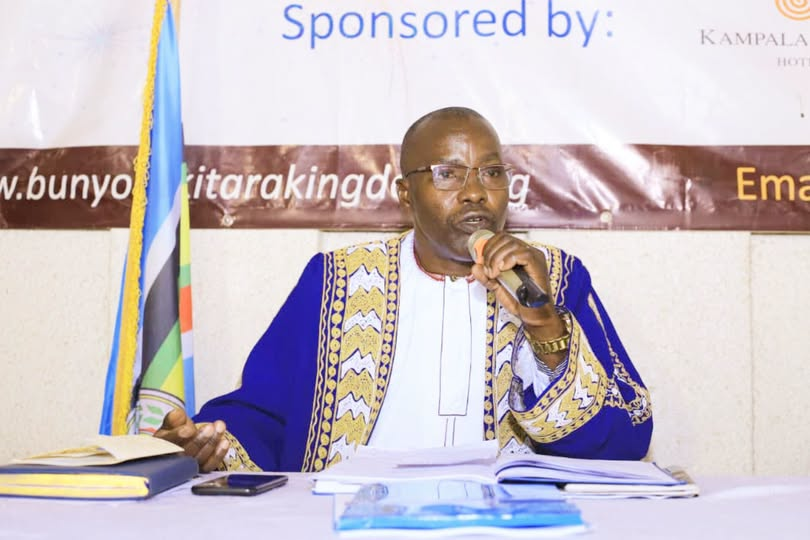
KAMPALA — Bunyoro-Kitara Kingdom has announced the death of Owek. Isaac Kalembe Akiiki, the long-serving Speaker of the Kingdom’s Parliament and a prominent writer and researcher of Bunyoro’s history and culture.
Kalembe died in Kampala on Tuesday, August 18, 2026, according to a death announcement issued by Bunyoro-Kitara Kingdom. He was remembered as a servant of the Kingdom who devoted much of his life to documenting its history, culture and heritage.
The announcement said funeral arrangements would be communicated later.
Kalembe served as Omutalindwa, the Speaker of the Bunyoro-Kitara Kingdom’s Rukurato, its traditional parliament. Uganda Radio Network reported in 2020 that he chaired a special session of the Kingdom’s Parliament held to honour former Bunyoro Prime Minister Prof. Barongo Yolamu.
Beyond his role in the Kingdom’s political and cultural institutions, Kalembe was a prolific writer on Bunyoro history.
He authored Omukama Cwa II Kabaleega: A Life and Legacy, 1853–1923, a substantial biography of Omukama Kabalega. The book is listed in the catalogue of the Uganda Christian University Library, which identifies Kalembe as its author.
His contribution to historical research was also recognised by the Kabalega Foundation, which listed Kalembe Isaac Akiiki among recipients of its 100 Years of Kabalega Commemoration awards for Historical Research and Documentation.
A voice on Bunyoro’s history
Kalembe’s work extended beyond his book on Kabalega.
He wrote extensively about Bunyoro’s customs, traditions, clans, historical figures and cultural practices. His published work includes articles on the history of beer brewing and the omwenge culture in Bunyoro, the significance of names in Bunyoro-Kitara and the history of Kooki.
In one account of his work, Kalembe said he had been involved in editing the Bunyoro-Kitara Journal since 2014 and subsequently undertook research into the Kingdom’s history, culture and people. A Pan-African cultural publication described him as the Kingdom’s Omutalindwa and quoted him discussing the preservation of Bunyoro’s historical knowledge.
His work also took him into conversations about Uganda’s wider cultural and historical identity.
His voice lives on in Tuko Pamoja
Kalembe was also one of the voices featured in the documentary series Tuko Pamoja, which explored the histories, cultures and shared identity of Uganda and the wider East African region.
During production, the Nyati Motion Pictures crew interviewed Kalembe at the Kibiro salt mines in Bunyoro. He was featured in connection with his work on Kabalega’s history and his book on the former Omukama. SoftPower News, which covered the premiere of the Bunyoro and Buganda segments, identified him among the project’s interviewees.
He was a Bunyoro historian, author and cultural researcher. The Bunyoro segment of Tuko Pamoja explored the Kingdom’s history and included discussion of Omukama John Cwa II Kabalega, one of the most prominent figures in the region’s resistance to British colonial expansion.
A custodian of Bunyoro’s memory
The Kingdom’s announcement described Kalembe as a writer and collector of Bunyoro-Kitara’s history and linked his work to the Royal Historical Society.
His death removes from Bunyoro’s cultural institutions a figure who occupied an unusual space: he was simultaneously a Kingdom official, parliamentarian, writer, researcher and custodian of historical memory.
His writings attempted to preserve knowledge that is often transmitted orally, including traditions, names, places, customs and accounts of the Kingdom’s past.
The death announcement was issued by Bunyoro-Kitara Kingdom Prime Minister Andrew Byakutaga Ateenyi, who conveyed condolences to Kalembe’s family, the Kingdom’s institutions, religious leaders, elders and the wider Bunyoro community.
Funeral arrangements are expected to be announced by the family and the Kingdom.
Kalembe’s contribution to documenting Bunyoro’s past will remain particularly significant through his writings, including his biography of Kabalega, and through the recorded interviews in which he explained Bunyoro’s history to a wider Ugandan and African audience.

