



By Investigative Desk
Kampala, Uganda — As investigations continue into the fatal crash along the Mbarara–Bushenyi Road, attention is shifting from the immediate tragedy to a broader and more difficult question: who will ultimately be held accountable?
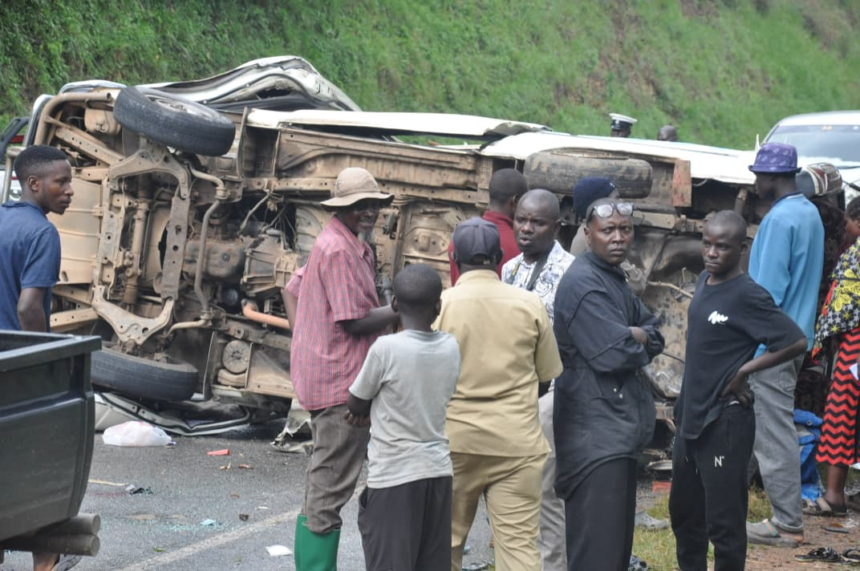
The collision, involving a passenger taxi (UBE 047S) and a heavy truck travelling from Mbarara, left one person dead and several others seriously injured. While authorities are still piecing together what happened, past cases suggest that determining responsibility in such incidents is often complex—and sometimes inconclusive.
Police begin investigations
The Uganda Police Force has opened a case file, with traffic officers documenting the scene, inspecting the vehicles, and recording witness statements.
Police spokesperson ASP Samson Kasasira said investigators are working to establish the cause of the crash.
“We are gathering evidence, including eyewitness accounts and vehicle conditions, to determine the cause of the crash,” he said.
Investigations typically examine factors such as speed, driver conduct, vehicle condition, and road environment—though conclusions can take time and are not always publicly detailed.
When does a crash become a crime?
Under Ugandan law, a fatal accident may lead to criminal charges, including causing death by dangerous driving, if negligence is proven.
Kampala-based lawyer David Kato said the legal threshold is high.
“It must be proven that a driver acted recklessly or failed to exercise reasonable care,” he explained.
However, establishing negligence is often difficult, particularly where accounts conflict or evidence is limited.
Possibility of shared responsibility
Legal experts note that liability does not always rest with a single individual. In some cases, multiple factors—including the actions of both drivers or external conditions—may contribute to a crash.
“You may find that both drivers made errors, or that external factors like road condition played a role,” said Harriet Nambooze.
Such scenarios can complicate both criminal prosecution and civil claims.
Vehicle owners under scrutiny
Accountability may also extend beyond drivers to vehicle owners, especially in Uganda’s commercial transport sector.
Mr. Kato noted that poor vehicle maintenance or pressure on drivers to meet daily financial targets can contribute to unsafe conditions.
These operational arrangements—common in taxi and trucking businesses—often place drivers under strain, potentially affecting decision-making on the road.
Compensation challenges for victims
For victims and their families, justice is not only about determining fault but also securing compensation. While motor vehicle insurance is mandatory, accessing payouts can be a prolonged process.
Legal aid advocate Samuel Twinomujuni said many families struggle to navigate claims.
“It can take months or even years, yet families are already dealing with medical bills, burial costs, and loss of income,” he said.
Concerns over weak accountability
Road safety advocates argue that many accident cases in Uganda rarely reach clear or publicly communicated conclusions.
Campaigner Stephen Rwomushana said this weakens deterrence.
“Many cases fade away after the initial investigation. The public rarely hears what happened next,” he said. “If drivers and companies know they are unlikely to face consequences, behavior does not change.”
Beyond drivers: systemic issues
Some experts caution against focusing solely on individual drivers, pointing to broader systemic challenges.
Transport policy analyst Michael Rwakahima said infrastructure and enforcement gaps can also play a role.
“If a road is known to be dangerous and nothing is done, that is also a form of accountability,” he noted.
Factors such as poor road design, inadequate signage, and weak enforcement mechanisms are often cited as contributing to recurring accidents.
Families seek answers
As investigations continue, affected families remain in uncertainty, waiting for clarity on what caused the crash and who is responsible.
“We want to know what really happened and who is responsible,” said Annet Kemigisa.
A test of accountability
For many observers, the outcome of the investigation will determine whether the incident becomes just another statistic or prompts meaningful accountability.
Without sustained public attention and transparent follow-up, critics warn that even fatal accidents on major routes risk fading without resolution.
As the case unfolds, one question remains at the centre of the tragedy: will it lead to accountability—or become another unanswered chapter on Uganda’s roads?

