



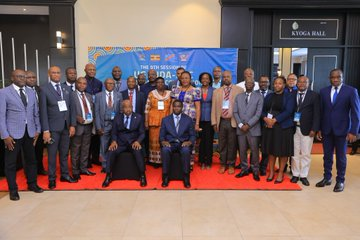
Seventeen ministers from the Democratic Republic of Congo (DRC), led by Deputy Prime Minister Lukoo Shabani, are in Uganda for the 9th Uganda–DRC Joint Permanent Commission (JPC), marking one of the largest ministerial delegations ever to attend the bilateral platform.
The high-level delegation, confirmed by the Embassy of Uganda in the DRC, described the visit as “history in the making,” as both countries move to deepen cooperation across security, trade, infrastructure, and regional integration.
“History in the making! 🇺🇬🇨🇩 Seventeen DRC Ministers led by Deputy Prime Minister Lukoo Shabani have arrived in Uganda for the 9th Uganda–DRC Joint Permanent Commission,” the Embassy of Uganda in the DRC posted, adding that the meetings will advance cooperation in “security, diplomacy, trade, infrastructure, and regional integration.”
The week-long engagement brings together top political leaders, permanent secretaries, and technical experts from both countries in structured discussions covering political and diplomatic affairs, economic cooperation, defence and security, as well as social and cultural integration.
According to programme details, the ministerial session—expected to be the highlight of the engagements—is scheduled for Sunday, May 10, while a possible bilateral heads of state engagement is being considered for Monday, subject to confirmation.
The Private Sector Foundation Uganda (PSFU), represented by Vice Chairperson Sarah Kagingo, also participated in parallel engagements with the DRC delegation, focusing on private sector-led growth.
“We are working to remove non-tariff barriers and formalise cross-border trade so that our MSMEs can compete and flourish in the vast DRC market,” Kagingo said during discussions under the theme “Scaling Shared Prosperity: Trade, Infrastructure, and Security.”
Ambassador John Leonard Mugerwa, who heads the Ugandan delegation, said the JPC remains central to strengthening long-standing relations between the two neighbouring countries.
“We are looking at trade, economic cooperation, infrastructure, defence and security, because defence and security is so important,” Amb. Mugerwa said. “We have ongoing cooperation between the DRC and Uganda and we’d like to see that improved so that we can have peace and stability and that can give us an environment for trade and investment.”
He added that Uganda and DRC share “deep historical, cultural, social and economic ties,” which continue to expand through structured bilateral cooperation.
The technical sessions have focused heavily on key cross-border infrastructure projects, including progress on the Kasindi–Beni road, which is now 60 percent complete, and the Beni–Butembo stretch, currently at 6 percent.
Discussions also include alignment on the Standard Gauge Railway (SGR) routes, aviation cooperation under a revised Bilateral Air Services Agreement, and the development of the Nkenda–Beni–Bunia–Butembo high-voltage power transmission line aimed at boosting regional energy connectivity.

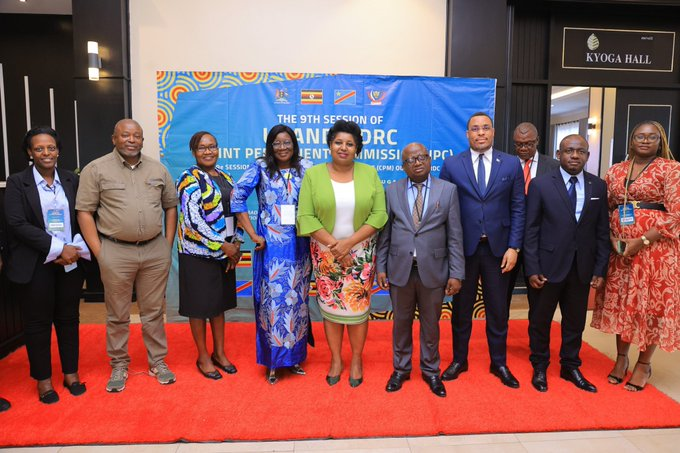
Security remains a major pillar of the talks, with delegations reviewing progress under Operation Shujaa, the joint Uganda–DRC military campaign against the Allied Democratic Forces (ADF) in eastern Congo. Technical border verification in sensitive areas such as Busanza is also under review.
The commission is further addressing humanitarian and legal concerns, including the management of nearly 500,000 Congolese refugees currently hosted in Uganda, alongside frameworks for judicial cooperation and prisoner transfer agreements.
On the economic front, discussions are focusing on eliminating non-tariff barriers and harmonising cross-border trade systems. A revised memorandum of understanding on trade cooperation is expected to be finalised during the session.
Uganda and the DRC also reaffirmed their commitment to regional integration through coordinated energy projects, hydrocarbons cooperation, and improved transport infrastructure linking the two economies.
Officials say the presence of 17 ministers underscores renewed political momentum behind the partnership, with expectations that the Kampala talks will produce concrete agreements to accelerate trade, strengthen security cooperation, and unlock investment across the shared border region.