



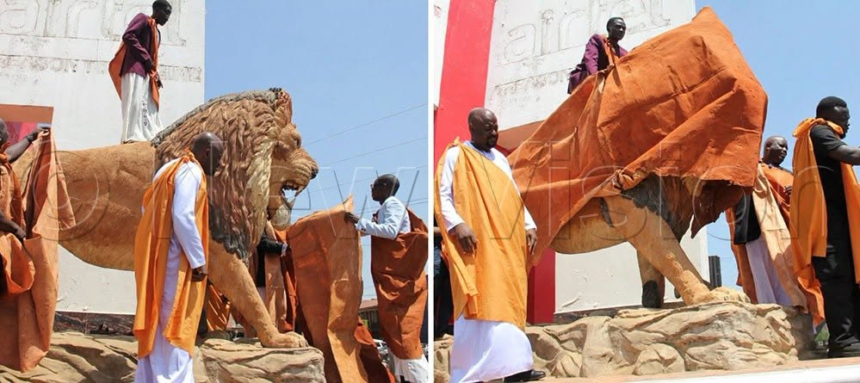
FORT PORTAL, Uganda — The lions that have long stood watch over Fort Portal have been covered in bark cloth as Tooro Kingdom begins a nine-day traditional mourning period following the death of King Oyo Nyimba Kabamba Iguru Rukidi IV.
The unusual sight across the city is not simply an expression of grief. It is a cultural statement: the Lion of Tooro is gone, and for the moment, the throne has no reigning monarch.
King Oyo died on Thursday, August 27, 2026, at about 10 p.m. while receiving medical treatment in the United States. He was 34. The kingdom formally announced his death on Friday and immediately began observing traditional mourning rites.
The covering of the lion sculptures was carried out at several prominent locations in Fort Portal, including the main city roundabout and the entrances to Karuziika Palace, the official seat of the Tooro Kingdom.
The statues were wrapped in orubugo, or bark cloth, as part of customs observed following the death of an Omukama.
In Tooro culture, the lion is closely associated with the authority of the king, who is traditionally described as “Entale ya Tooro” — the Lion of Tooro.
Zebadayo Mwesige, a former Tooro Kingdom Minister of Culture and performer of traditional rites, explained that the covered statues reflect the absence of a reigning king. “The sculptures have no significance at the moment because we have no King,” Mwesige said.
The lions are expected to remain covered until the succession process is completed and a new Omukama is selected and enthroned.
Richard Rwabuhinga, chairperson of the organising committee for King Oyo’s send-off, said the lion represents the power and authority of a reigning monarch.
“The lion, which is a major symbol of authority for the King, will be covered in the city centre, at the entrance of the palace, and all these other areas, because the lion has gone silent,” Rwabuhinga said.
The silence surrounding the lion is part of a wider transformation of the kingdom’s public symbols during mourning.
The royal drum, Engoma, has been turned upside down, a ritual symbolising the end of the monarch’s reign. The Tooro Kingdom anthem has also been suspended during the mourning period and will only resume after the enthronement of a new king. Kingdom flags are being flown at half-mast.
The rituals raise a question that modern Uganda often leaves unexplored: what happens to a kingdom when its king dies?
Uganda is a republic, and traditional kings and other cultural leaders do not exercise constitutional political authority. Yet the institutions they embody remain powerful custodians of history, identity and social memory. King Oyo’s death has therefore triggered not merely a funeral, but a carefully structured cultural transition.
Tooro Kingdom began the traditional mourning period, known as okugaragara, on Friday. According to kingdom officials, the period will involve a series of cultural rites leading to the burial of the monarch.
Daily ecumenical prayers are also being held at Karuziika Palace, while cultural officials have urged Batooro and other mourners to remain peaceful and united.
The kingdom’s head of clans, Omusuuga Charles Kamurasi, has assumed responsibility as custodian of the kingdom during the transition. He said no individual currently has the authority to act as Omukama until a successor is selected and enthroned.
The Tooro Kingdom has also confirmed that the continuity of the crown is assured. In its official announcement of King Oyo’s death, Prime Minister Calvin Armstrong Rwomiire Akiiki said the late king left behind a prince heir whose identity will be formally revealed at the appropriate time according to Tooro customs.
King Oyo’s own journey to the throne was extraordinary. He became Omukama in 1995 at just three years old following the death of his father, King Patrick David Matthew Kaboyo Olimi III. His accession made him the world’s youngest reigning monarch at the time, a distinction that brought international attention to the young king and Tooro Kingdom.
He eventually assumed full responsibilities as monarch after coming of age and was formally crowned in 2010.
Now, more than three decades after the little boy was placed on the throne, his death has brought Tooro to another symbolic beginning.
The drums have been inverted. The anthem is silent. The flags are lowered.
And the lions have been covered.
For a kingdom whose identity has long been expressed through the image of the lion, few gestures could say more about the death of its king.

