



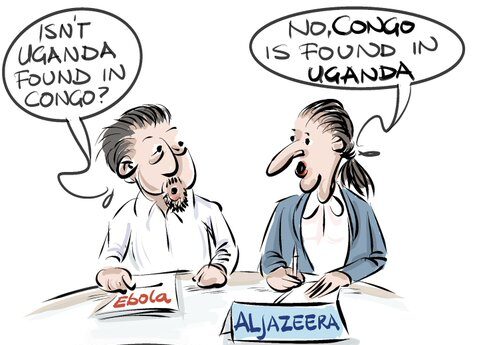
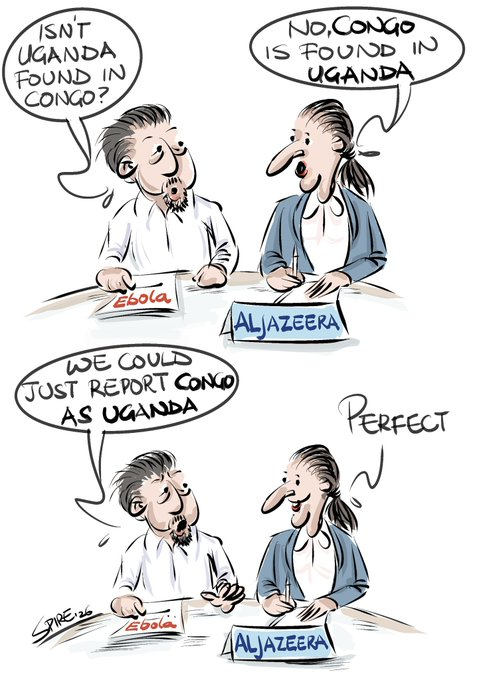
The newsroom is quiet. Two journalists sit at a desk under an Al Jazeera sign, trying to figure out where a health crisis is happening. This scene comes from a sharp cartoon by Dr Jim Spire Ssentongo.
“Isn’t Uganda found in Congo?” the male reporter asks, pointing to a paper marked Ebola.
The female reporter answers confidently: “No, Congo is found in Uganda.”
Instead of checking a map, the first journalist shrugs and says, “We could just report Congo as Uganda.” With a smile, his colleague replies, “Perfect.”
Dr Spire, a philosophy teacher, cartoonist and columnist, mocks a big problem with global news: the tendency to treat different African countries as if they are all the exact same place. To these foreign news desks, actual borders do not seem to matter. They reuse the same old story—treating the entire continent as one big zone of disease, helplessness, and failure.
When Health Agencies Make the Same Mistake
This lazy mixing of different countries does not just happen in cartoons. It happens in real life with global health organisations. A clear example of this happened during the mid-May 2026 Ebola outbreak.
When Ebola cases grew in the Ituri Province of the Democratic Republic of the Congo (DRC), Uganda’s health workers acted fast. They caught and isolated a few cases at the border, keeping the situation under control.
However, the official reports from regional groups like the Africa CDC and global media did exactly what Spire’s cartoon mocks. They lumped all the numbers together without making a clear distinction.

Uganda has since secured a correction from the Africa Centres for Disease Control and Prevention (Africa CDC) after officials raised concerns that Ebola outbreak figures published by the continental health agency had incorrectly combined Uganda’s cases with those from the Democratic Republic of Congo (DRC).
Uganda’s Permanent Representative to the United Nations, Ambassador Adonia Ayebare, said he held discussions with Africa CDC Director-General Dr Jean Kaseya, who agreed to rectify the reporting error and provide country-specific outbreak data.
“Today had a productive call with Dr Jean Kaseya, Head of Africa CDC, and he agreed to correct the errors in their reporting on Ebola cases in Uganda,” Ayebare said in a statement posted on X.
By mixing the hundreds of cases spreading in the DRC with the few isolated cases safely managed at the Ugandan border, the international reports made it look like a massive, out-of-control epidemic was destroying both countries.
The Real Damage of “Perfect” Headlines
This fight between Ugandan health officials and international agencies proves that misinformation does not just come from social media. It can also be created by big health organisations and sloppy news headlines.
When global networks broadcast scary warnings that “Ebola is spreading rapidly across the DRC and Uganda,” they are doing exactly what the journalists in the cartoon did. They are choosing a simple, frightening story over the truth.
For Uganda, this bad reporting causes real harm:
• Damage to the Economy: Lazily mixing a controlled border situation with a massive outbreak causes foreign countries to issue travel warnings. This stops tourists from visiting and hurts businesses.
• Loss of Public Trust: When local citizens see international news reporting a massive outbreak that is not actually happening on the ground, they stop trusting health officials. This makes people believe the virus is a lie or a political trick, making it much harder for doctors to treat real diseases in the future.
Spire’s cartoon is a powerful reminder that bad geography and sensational headlines are dangerous. When global media desks decide that reporting “Congo as Uganda” is perfect just to get more clicks, they are stop reporting the truth and start creating a dangerous lie.

