


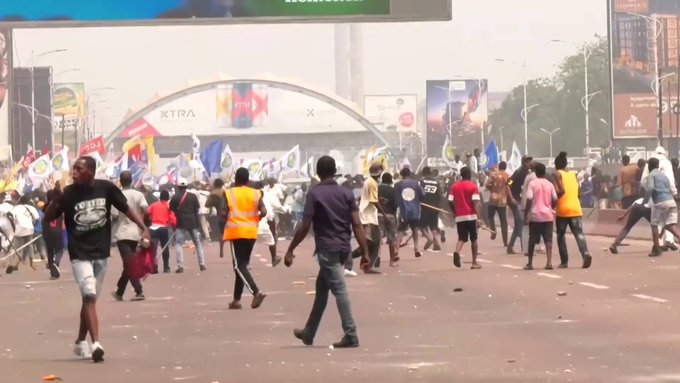
Hundreds of people took to the streets in Kinshasa and other cities in the Democratic Republic of Congo (DRC) on Tuesday to protest proposed constitutional changes that opponents say could allow President Félix Tshisekedi to seek a third term.
The demonstrations, organised by the opposition Coalition Article 64 (C64), were met with tear gas and warning shots from police in Kinshasa, where protesters also clashed with groups supporting the government.
Protests were also reported in Lubumbashi, Likasi, Kasumbalesa, Mbandaka and Kisangani, despite restrictions on public gatherings introduced amid the country’s Ebola outbreak.
In Kinshasa, the demonstration initially proceeded peacefully before clashes broke out between opposition supporters and pro-government groups. Police subsequently moved to disperse the crowd.
Opposition leader Martin Fayulu accused security forces of working with political groups linked to the ruling party and described the police response as violent. Government spokesperson Patrick Muyaya, however, said the right to protest is recognised by the Constitution but must be exercised lawfully, while accusing the opposition of spreading misinformation about Tuesday’s activities.
Reports of arrests varied across locations. Anadolu Agency, citing activists and local rights officials, reported dozens of arrests, including about 70 people in Haut-Katanga province, while activists in Mbandaka reported roughly a dozen arrests. Local police officials disputed some of the reports.
Opposition challenges constitutional reform
The demonstrations centre on a proposed overhaul of the country’s constitutional framework.
Tshisekedi has said he would be willing to seek another term if Congolese voters approve the move through a referendum. He has been president since 2019 and was re-elected in 2023, meaning his current second term is due to end in 2028.
The current Constitution limits a president to two terms and explicitly protects the presidential term limit from revision. A bill adopted by Parliament in June would, however, provide a route towards a referendum on constitutional changes under circumstances described in the legislation as a “major dysfunction” paralysing state institutions.
The opposition argues that the proposed changes could effectively reset the presidential term count and open the way for Tshisekedi to remain in office beyond 2028.
C64, whose name refers to Article 64 of the Constitution, was formed by opposition parties and political figures to challenge the proposed reforms. The coalition has described the initiative as an attempt to alter the constitutional order to extend Tshisekedi’s rule.
The government and supporters of the reform have presented the constitutional process differently, arguing that Congolese citizens should have the opportunity to decide through a referendum.
Tensions follow earlier clashes
Tuesday’s protests were not the first confrontation over the proposed constitutional changes.
A June demonstration in Kinshasa organised by C64 was also dispersed by police with tear gas after clashes between opposition supporters and pro-government activists. Several opposition figures, including Fayulu, were injured during that confrontation.
In July, C64 postponed another planned demonstration following Tshisekedi’s announcement of a national dialogue. The coalition had agreed to suspend the action following appeals from Catholic and Protestant church leaders, who were expected to help mediate the political dispute.
The opposition subsequently resumed its mobilisation, culminating in Tuesday’s nationwide protests.
The Catholic Church has been among the voices expressing concern over constitutional changes that could affect presidential term limits, while opposition leaders have portrayed the proposed reforms as an attempt to retain power. Other political actors supporting the reform argue that the constitution can be changed through the established legal process and ultimately submitted to voters.
Political dispute unfolds amid Ebola and eastern conflict
The confrontation is unfolding as the DRC deals with multiple crises.
The country is responding to a spreading Ebola outbreak, while fighting continues in eastern DRC involving the Rwanda-backed M23 armed group and other armed organisations. The government has also linked the holding of future elections to security and stability in the country.
The proposed constitutional changes have therefore become part of a broader political dispute over the country’s direction ahead of the 2028 presidential election.
For now, the constitutional process remains contested, with the government pursuing a referendum route and C64 seeking to block changes that it says could allow Tshisekedi to remain in power beyond the current two-term limit.

