


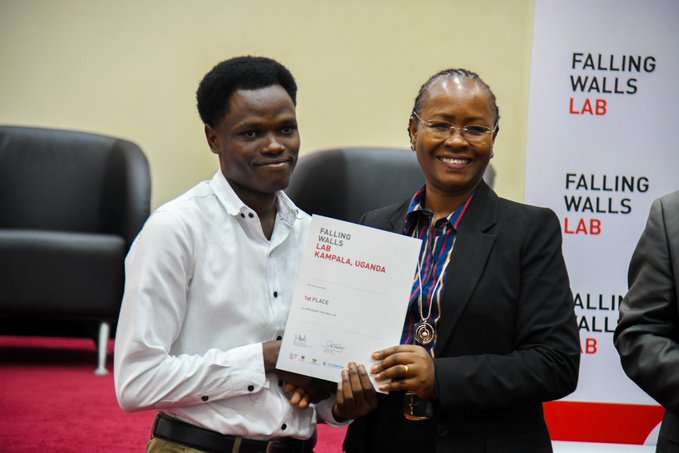
Makerere University innovator Andrew Mudhasi has won the Falling Walls Lab Kampala 2026 competition with a low-cost device designed to screen newborns for jaundice.
Mudhasi emerged as the overall winner with his innovation, BiliBright, which is aimed at providing an affordable way of screening neonatal jaundice, scoring 90%.
He presented a low cost device for newborn jaundice screening that uses optical sensor technology and a skin tone targeting algorithm. In lab testing, it recorded 94% accuracy.
He emerged top from a strong field of researchers and students who pitched solutions in healthcare, agriculture, clean energy, waste management, and community resilience.
Makerere University Vice Chancellor Prof. Barnabas Nawangwe announced the results, congratulating the top three innovators and describing the quality of the pitches as impressive.

As the winner, Mudhasi received a flight ticket to Berlin, Germany, where he will represent Uganda at the Falling Walls Science Summit.
Nawangwe said the competition showcased young innovators developing solutions to real-world challenges. “I was truly impressed by the quality of pitches by our young innovators,” Nawangwe said.
The competition was organised by the Alliance for African Partnership (AAP) Africa Office and marked the first Falling Walls Lab held at Makerere University.
The first runner-up was Rhoda John of the University of Nairobi, whose innovation focused on “Breaking the Wall on Non-Recyclable Hygiene Waste.”
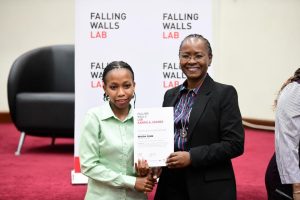
Stuart Mayira of Makerere University emerged second runner-up with an innovation titled “Breaking the Wall Between Nature and Modern Medicine.”
Falling Walls Lab is an international innovation and science competition that allows young researchers and innovators to present ideas aimed at addressing major societal challenges.
The Kampala competition brought together innovators to pitch their ideas, with the top-ranked participant earning an opportunity to present on an international platform in Berlin.
Nawangwe congratulated the three finalists and praised the participants for developing what he described as bold ideas with potential real-world impact. “I congratulate our innovators for turning bold ideas into solutions with real-world impact!” he said.

