



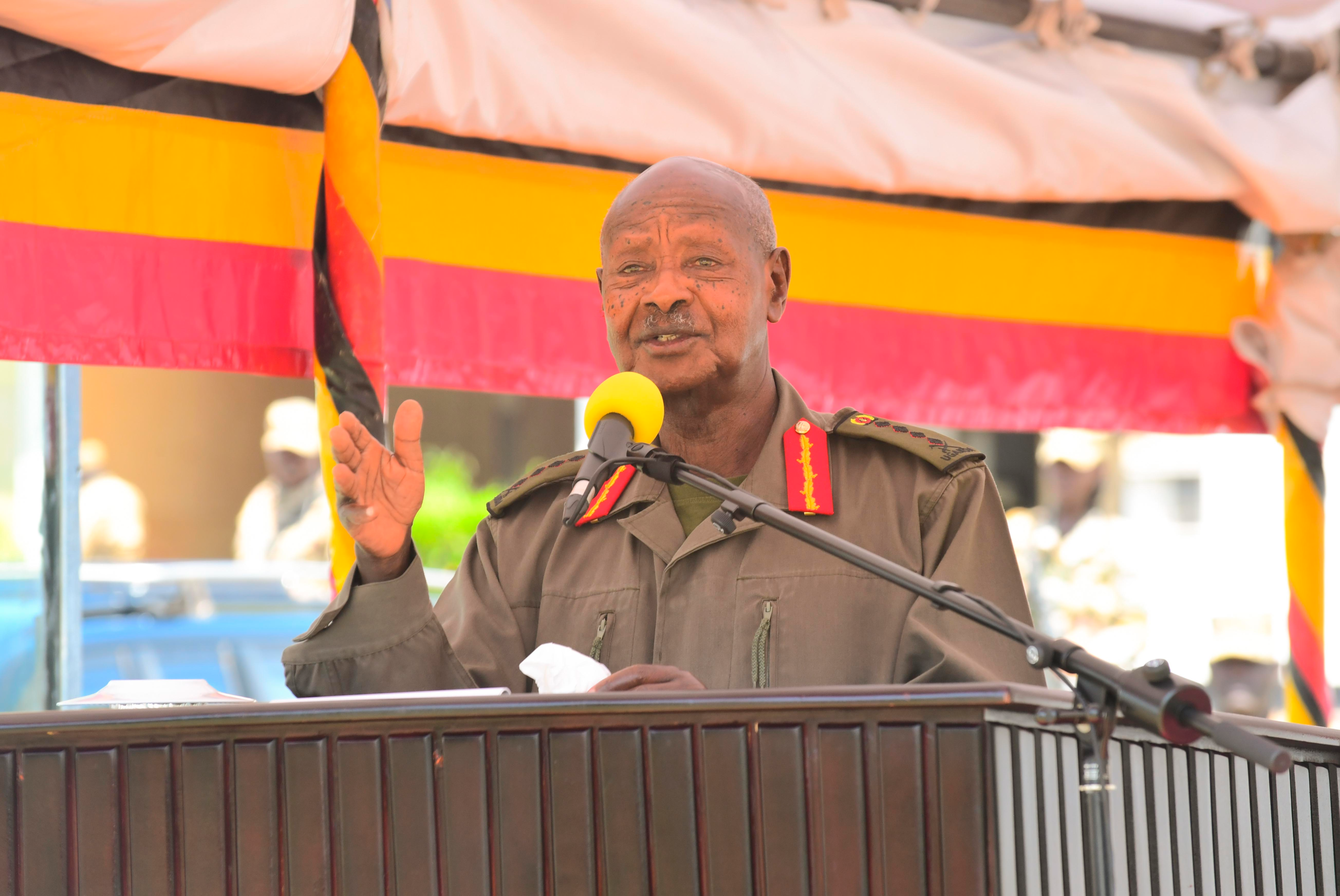
JINJA, Uganda — President Yoweri Kaguta Museveni has challenged East African leaders to embrace deeper regional integration, warning that personal political interests and the desire to maintain power within small national jurisdictions could undermine the region’s long-term security and economic future.
Speaking to senior military officers at the Senior Staff College-Kimaka in Jinja, President Museveni said East Africa’s ability to address future security challenges and achieve sustainable prosperity depends on political integration beyond existing national boundaries.
The President argued that while East African countries have made progress in promoting economic cooperation, political integration remains slow because some leaders are reluctant to cede influence in favour of a larger regional framework.
“We have been talking about East African integration, but if Presidents want to remain big fish in small ponds, then that issue will not be addressed,” President Museveni said.
The remarks appeared to reflect long-standing frustrations over the slow pace of regional integration within the East African Community (EAC), a bloc that brings together countries including Uganda, Kenya, Tanzania, Rwanda, Burundi, South Sudan, the Democratic Republic of Congo and Somalia.
President Museveni said Africa’s future prosperity depends on the creation of larger markets capable of supporting industrialization, job creation and technological advancement.
According to him, the National Resistance Movement (NRM) has for decades advocated economic integration as one of the key historical missions needed to transform Uganda and the continent.
“The first historical mission is how to ensure prosperity of our people. We have told you that one of the factors to help you prosper is economic integration of the African market,” he said.
The President urged younger generations to continue pushing for integration, arguing that fragmented economies and colonial-era borders limit Africa’s ability to compete globally.
Beyond economic considerations, President Museveni emphasized that political integration is increasingly becoming a security necessity in an era of rapidly evolving global threats.
He noted that modern military and technological capabilities now extend beyond traditional land and sea operations to areas such as space exploration and advanced defense systems.
“We must be able to operate on land, air, navy and in space, but can Uganda have a space programme? Or can we go to the ocean? No, we are cut off by the irrational colonial borders,” he said.
President Museveni maintained that a politically united East Africa would be better positioned to defend its interests, harness its resources and compete with major global powers.
He also criticized identity-based politics rooted in tribe and religion, describing such approaches as obstacles to broader national and continental development.
“The politics of identity is politics of parasites,” he said.
The President further highlighted commercial agriculture, manufacturing, services and Information and Communication Technology (ICT) as the four sectors that should drive wealth creation and employment across Uganda and the region.
The lecture was attended by officers undertaking the Senior Staff Course at Kimaka, including participants from Uganda and several other African countries.
The Commandant of the Senior Staff College-Kimaka, Brig. Gen. Michael Kabango, thanked President Museveni for engaging the officers and sharing insights on regional security, development and strategic leadership.
Museveni’s comments add to a long-standing debate about the future of East African integration, a vision he has consistently championed as essential for both economic transformation and collective security in the region.

