



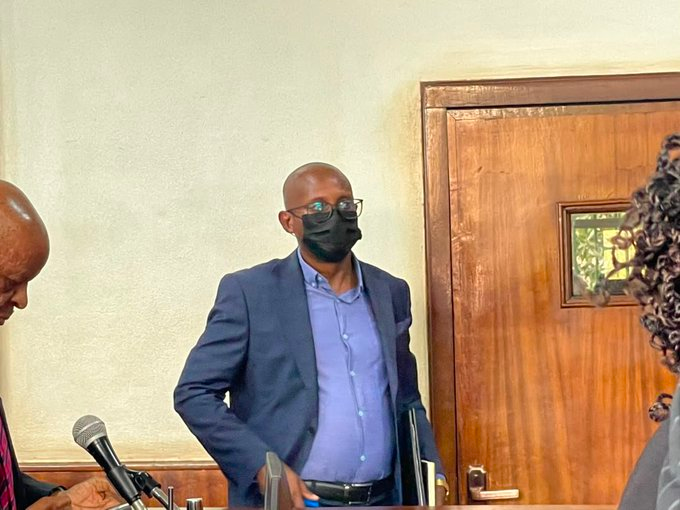
KAMPALA — The Chief Magistrate’s Court at Buganda Road has ordered the extradition of retired Lieutenant Katungi Michael Mpeirwe to the United States, where he faces charges of drug trafficking, firearms offences and providing material support to a designated foreign terrorist organisation.
The ruling was delivered on Friday by Chief Magistrate Ritah Kidasa Neumbe, who found that the Director of Public Prosecutions (DPP) had satisfied the legal requirements for extradition under Uganda’s Extradition Act, Cap. 124.
The court consequently committed Katungi to prison pending his surrender to US authorities.
The extradition request was made by the Government of the United States, which seeks to have Katungi stand trial before the US District Court for the Eastern District of Virginia.
He faces three charges:
- Conspiracy to distribute and possess with intent to distribute five kilograms or more of cocaine.
- Conspiracy to possess firearms, including a machine gun and destructive device, in furtherance of a drug-trafficking crime.
- Conspiracy to provide material support to Cartel de Jalisco Nueva Generación (CJNG), which the US has designated as a foreign terrorist organisation.
The Republic of Uganda, represented by the DPP, was the applicant in the extradition proceedings. Adrine Asingwire, a Chief State Attorney with the Office of the DPP, argued the case.
The court dismissed preliminary objections raised by Katungi, including challenges to the procedure used to initiate the extradition proceedings, the authority of the Minister of Justice and Constitutional Affairs and the Solicitor General to process the US request, a claim of diplomatic immunity and an argument that the DPP lacked legal standing to conduct the proceedings.
On diplomatic immunity, the court held that such protection applies in the receiving country where a diplomat is accredited and does not extend to legal proceedings in Uganda or third countries.
The court also affirmed the constitutional authority of the DPP under Article 120 of the Constitution to institute and conduct proceedings of this nature on behalf of the State.
The magistrate noted that an affidavit filed by Michael D. Stanton in support of the extradition application had previously been removed from the court record after Stanton failed to appear for cross-examination.
However, the court found that the remaining evidence was sufficient to meet the threshold required for extradition.
This included an affidavit by D/SSP Kule Yona and authenticated documents submitted by US authorities.
The court further found that Katungi had been properly identified, that the alleged offences were not political offences and that the principle of dual criminality had been satisfied.
Dual criminality requires that the conduct alleged against a person constitute an offence in both the requesting and requested countries.
In this case, the court found that the alleged conduct corresponded with offences under Ugandan law, including drug trafficking, unlawful possession of firearms and terrorism-related offences.
The court stressed that extradition proceedings are not a criminal trial and therefore do not require prosecutors to prove the allegations beyond reasonable doubt.
Instead, the proceedings determine whether sufficient evidence exists to justify committing the person for surrender under the Extradition Act.
The court also rejected an argument that the absence of a Ugandan police file invalidated the proceedings, noting that the alleged offences were committed outside Uganda and that the case was supported by authenticated evidence from US authorities.
Katungi will remain on remand while awaiting the Minister’s order concerning his surrender to the United States.
The court directed that any extradition must be governed by the principle of specialty, meaning that once surrendered, Katungi may only be prosecuted in the United States for the offences specified in the extradition request, subject to the applicable law.
Despite the committal order, Katungi retains the right to challenge the decision through the legal avenues available to him.
The case now moves from the courtroom determination on extradition to the question of whether and when Uganda will surrender the retired officer to US authorities.
The DPP described the ruling as a successful outcome for its extradition application, while the court’s decision establishes that the evidentiary threshold for extradition can be met through properly authenticated foreign evidence even where the alleged crimes were committed outside Uganda.

