



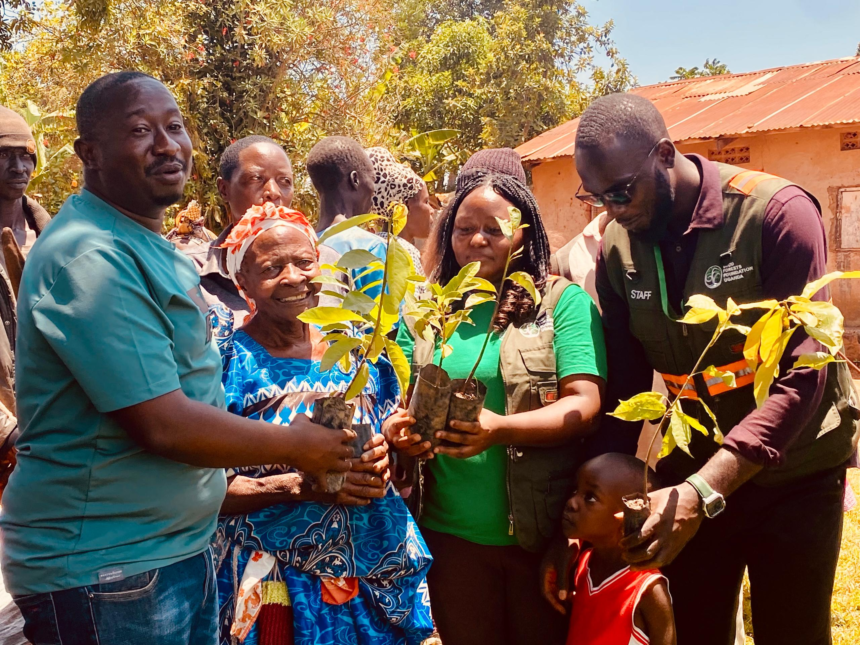
MUKONO — Residents of Bamutakudde Village in Kyampisi Sub-county, Mukono District, have turned the monthly National Cleaning Day into a wider community campaign to improve sanitation, increase tree cover and create a greener environment.
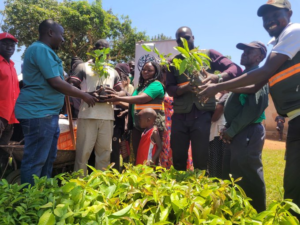
The residents, led by LC1 Chairman Solomon Serwanjja, spent Saturday cleaning village roads before planting 1,000 tree seedlings along roads and distributing fruit trees to households.
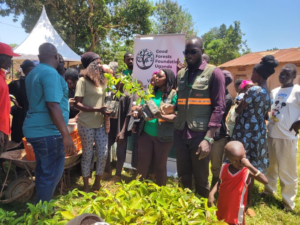
The exercise was supported by the Good Forests Foundation Uganda, which provided 2,000 seedlings, including 1,000 fruit trees and 1,000 indigenous tree species.
Serwanjja said the tree-planting exercise was part of the village’s broader effort to make environmental cleanliness a permanent community practice rather than an activity carried out only on the last Saturday of every month.

“I really want to appreciate the people of Bamutakudde Village for their unity. Every time I call on them, they turn up,” Serwanjja said. “In Bamutakudde, we clean every Saturday.”
The chairman said residents have adopted measures aimed at discouraging littering and improving waste management, including plans to install separate dustbins for recyclable and decomposable waste.
“If we find you throwing a bottle or rubbish on the road and you don’t pick it up, you will sweep the entire road,” he said.
Serwanjja said the community plans to place at least two dustbins on every village road, with additional bins along the Bamutakudde Highway.

But Saturday’s exercise went beyond sweeping and collecting rubbish. Residents dug pits, planted trees and watered the newly planted seedlings.
“Every Saturday, we wake up, open roads, sweep, collect rubbish and do community work. But this Saturday is special because we committed ourselves to planting trees,” Serwanjja said.
He said the village had received support from several well-wishers, including Good Forests Foundation Uganda, after he wrote requesting assistance.
Some of the trees have been planted along the highway, while others have been reserved for village roads and homesteads.
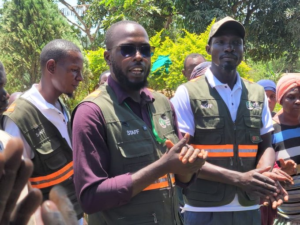
For Simon Jacob Ssekkajja, a farmer training facilitator at Good Forests Foundation Uganda, the initiative demonstrates how environmental restoration can begin at the village level.
“Today, we are here in Bamutakudde, with the chairman, supporting an initiative to create green spaces within his community. We are very proud to be part of this initiative.”
Ssekkajja said the foundation views trees not merely as environmental assets but also as part of a response to climate change and food insecurity.
“Our vision is that a good forest can be a climate solution. We hope that by the time the chairman’s term comes to an end, his community will be cooler and have more shade trees for the people,” he said.
The foundation also distributed fruit seedlings, including oranges and avocados, which Ssekkajja said would contribute to household nutrition while improving the environment.
“When we give communities fruit trees, we enrich their nutrition and improve their health,” he said.
“We also believe that creating shade trees alongside the main road in Bamutakudde will improve the scenery of the area and make the village cooler. Trees planted along roads can help cool the environment, and in the long run, this can contribute to building a climate-resilient community.”
Ssekkajja urged other community leaders to adopt similar initiatives, arguing that small-scale action across thousands of villages could have a national impact.
“I would call this an eye-opener for other community leaders. Leaders should come forward and stand up for their communities by creating more green spaces in their villages,” he said.
“I think that, at a small scale, if every village could plant about 300 trees, by the time we add that up at the national level, we would have significantly increased Uganda’s forest cover.”
The response from residents, he said, also suggested that attitudes towards environmental protection were changing.
“When I look at how the residents have responded and how they have embraced the initiative to plant trees and create green spaces in their communities, it gives me hope that perhaps we are changing the mentality of people in Uganda,” Ssekkajja said.
The tree-planting campaign was incorporated into Uganda’s National Cleaning Day, observed on August 29, when communities across the country participated in cleaning roads, markets and public spaces.